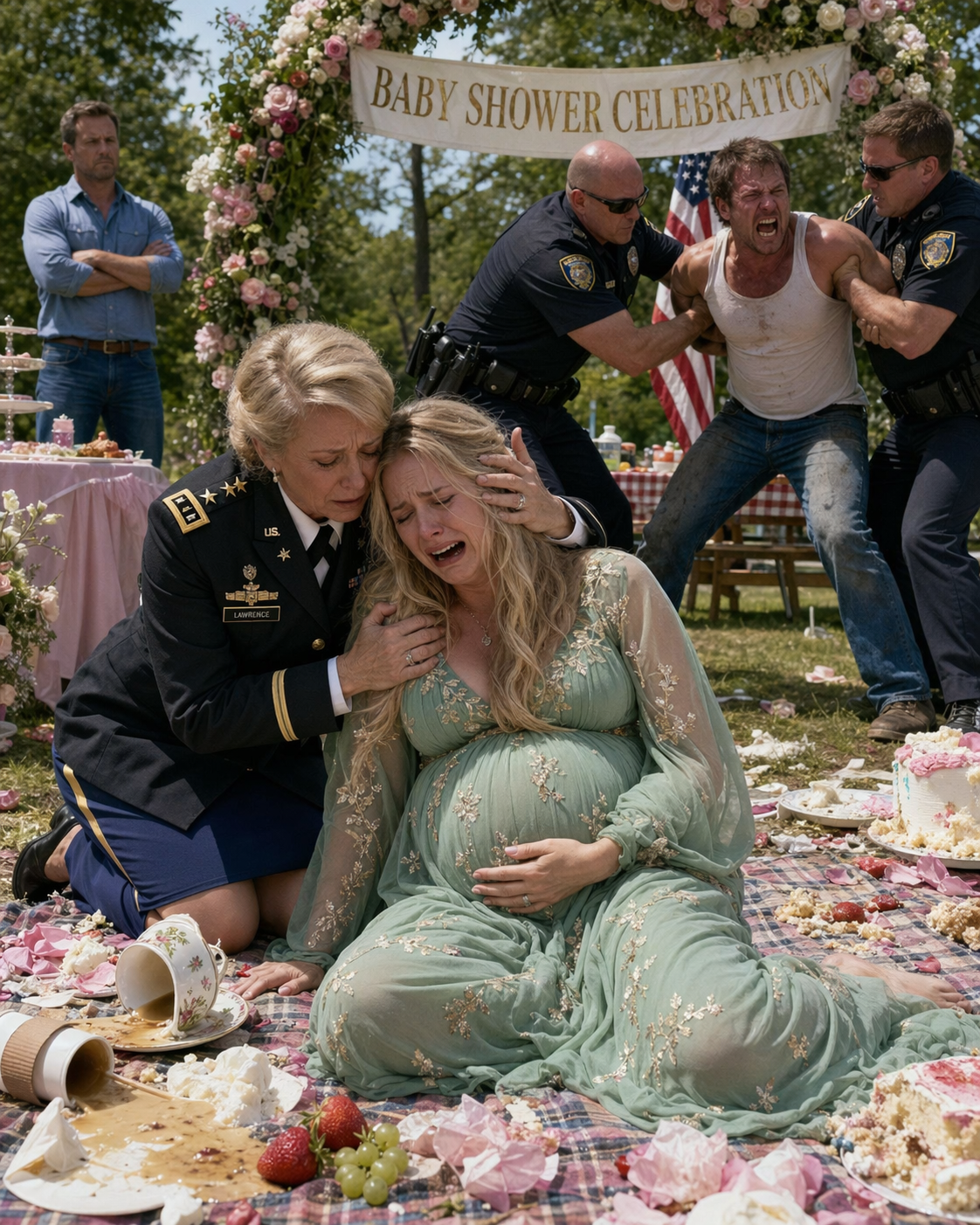
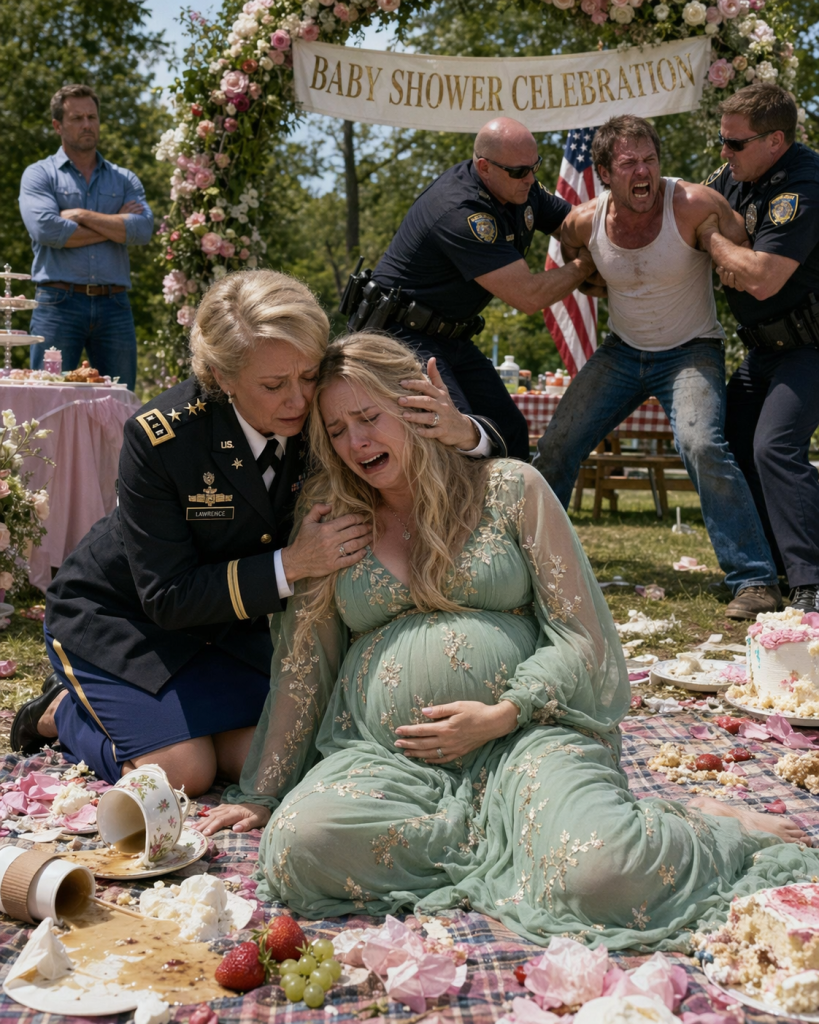
What they forgot was simple.
Ten years ago, I was the one who put their CEO behind bars.
So while they gathered around the table for Easter dinner—smiling, laughing, acting as if they were untouchable—the lights suddenly went out.
The room fell silent.
Then I stepped into the darkness wearing my old badge and said,
“Dinner’s over. You’re going somewhere they don’t serve turkey.”
The ambulance doors slammed shut behind us, sealing out the blizzard—but not the fury burning in my chest.
Emma lay strapped to the stretcher, an oxygen mask covering her face, her lashes wet with melted snow. One paramedic cut away the blood-stiffened fabric of her nightgown while another checked her abdomen with quick, practiced hands. I stood beside her, one hand locked around the metal rail so tightly my knuckles blanched white, the folded ledger page hidden inside my coat pocket like a second heartbeat.
“How far along is she?” the paramedic asked.
“Twenty-eight weeks,” I said.
He gave a single grim nod. “We’re treating this as trauma to both mother and baby.”
Both mother and baby.
Those words should have comforted me. They should have sounded like hope.
But all I could hear was Emma’s broken whisper at the terminal.
He pushed me.
Not I fell.
Not it was an accident.
He pushed her.
The ambulance swerved through the icy streets, its siren screaming into the storm. Beneath the blankets, Emma’s fingers twitched weakly, searching, and I took her hand at once.
“I’m here,” I said.
Her eyes fluttered open for half a second. “Mom…”
“You do not speak,” I told her softly. “You save your strength.”
Her lips trembled. “The ledger… in my pocket…”
“I have it.”
A tear slipped down the side of her face.
“He knew I found out.”
I leaned closer. “Then he made his last mistake.”
The paramedic shot me a sharp look. I offered him nothing more.
I had spent twenty-three years inside federal investigations. Financial crimes. Racketeering. Shell corporations. Offshore channels. Political payoffs. Charitable fronts. Disappearing witnesses. Over the years, men had called me many things—cold, relentless, impossible, merciless. But one name stuck.
It began as a whisper from a mob accountant in Newark, and by the end it had spread through half the white-collar criminals on the East Coast.
The Viper.
Not because I was loud.
Because I waited.
Then I struck once.
And I never missed.
At Saint Catherine’s Medical Center, they rushed Emma through double doors and into surgery. Placental abruption. Internal bleeding. Possible fractures. Shock. Hypothermia. A younger doctor tried to explain everything at once, but I had heard enough trauma briefings in my life to translate the panic behind his calm voice.
She was in danger.
The baby was in danger.
And if they survived the night, it would be because medicine outran cruelty by a matter of minutes.
A nurse with kind eyes guided me toward the waiting area. I did not sit.
I stood by the window and watched snow hurl itself against the glass in white sheets. Hospital lights threw my reflection back at me: silver hair pinned hastily beneath a wool hat, coat soaked through, boots crusted with ice, expression carved from something harder than anger.
I took the ledger page from my pocket and unfolded it carefully.
Even with only one page, I could already see the structure.
Three columns of handwritten transfers. Dates. Dummy vendors. Repeated references to a foundation called The Whitmore Family Restoration Trust. Large sums moved in staggered intervals. Matching initials in the margins. One partially visible account number—enough to identify the bank branch if I needed to.
And at the bottom, in Sebastian’s unmistakable hand:
Move Easter disbursement after dinner. CEO approval not needed. M. signed off.
M.
Margaret.
For a long moment, I simply stared.
Ten years earlier, I had put Sebastian’s father, Charles Whitmore, behind bars for securities fraud, bribery, and laundering money through a network of art acquisitions and overseas “consultancies.” Everyone said Charles had been the mastermind. Everyone said the empire would be clean once he was gone.
I had never believed that.
Men like Charles Whitmore do not build criminal systems alone.
They build families strong enough to carry them.
Sebastian had learned the lessons.
Margaret had perfected them.
And Emma—my sweet, trusting Emma—had found the proof.
No wonder they wanted her discarded before dawn.
I reached for my phone and dialed a number I had not used in eight months.
He answered on the first ring.
“Daniel Hayes.”
“It’s Evelyn.”
A brief silence. Then his tone changed.
“What happened?”
Good men always know when a call comes too late at night to be social.
“My daughter is in surgery,” I said. “Domestic assault. Attempted murder, if the doctors confirm what I think they will. And I have documentary evidence linking Sebastian Whitmore and Margaret Whitmore to money laundering through the Whitmore Restoration Trust.”
Daniel exhaled slowly. “Are you certain?”
“Daniel.” I kept my eyes on the operating room doors. “Do not insult me tonight.”
Another pause.
“No, ma’am,” he said quietly.
He still called me that, even though I had retired seven years ago and he now outranked half the people who once intimidated him.
“What do you need?” he asked.
“A secure team. No local leaks. No courtesy calls. No favors for the Whitmores. I want warrants built clean and fast—but I also want them desperate enough to make a mistake before Easter dinner.”
“Easter dinner?”
“They gather every year at Margaret’s estate. Family, attorneys, the house manager, the business controller, even some clergy friend if she wants the room to smell holy while it rots.”
He gave a short, humorless laugh. “You haven’t changed.”
“I have,” I said. “I bake more.”
His voice hardened. “Send me everything.”
“I have one page now. My daughter may know where the rest is if she wakes up. Pull the old Charles Whitmore files too. Look for dormant shell companies revived under restoration, preservation, or donor-trust language. Sebastian is laundering through the same skeleton in a cleaner suit.”
“I’ll wake financial crimes.”
“Wake homicide too.”
That silenced him.
“You think they meant for her to die,” he said.
I turned the ledger page over in my hand. “They left a pregnant woman bleeding in a blizzard in a nightgown.”
“I’m on it.”
I ended the call and finally sat down.
Only then did I realize my body was trembling.
Not from fear.
From restraint.
Emma survived surgery.
The baby survived too.
A little girl—still unborn, but stubborn—held on with a heartbeat the doctor described as “beautifully strong, considering the trauma.” Emma had a broken wrist, bruised ribs, a concussion, and enough blood loss to keep her under observation for days. But she was alive.
Alive.
I thanked the doctor once.
Then I asked for his exact wording regarding the injuries, the mechanism of impact, and the risk profile to both mother and child. He stared at me for a moment, perhaps surprised by the precision of the request.
Then he answered each question carefully.
I had not forgotten how to build a case.
By dawn, Daniel had two agents at the hospital and one prosecutor reviewing emergency warrant language. By noon, the security footage from Port Authority had been preserved.
It showed Sebastian’s black SUV pulling into the drop-off lane at 12:11 a.m.
It showed him opening the passenger door.
It showed Emma falling—not stepping—onto the icy pavement.
It showed him slipping something into her coat pocket.
It showed him getting back into the vehicle and driving away.
Leaving her there.
At 12:14, she tried to stand and collapsed.
At 12:26, the security guard found her.
At 1:03, I arrived.
The footage was grainy, but intent does not require perfect lighting.
Only a pattern.
And the pattern was there.
Daniel came to the hospital that evening in a storm-dark overcoat, carrying a folder thick enough to crack a liar’s confidence on sight.
There was more gray in his beard than the last time I had seen him, more authority in the way he held himself. But his eyes were the same—steady, intelligent, watchful.
Emma was sleeping when he arrived, so we stepped into the corridor.
“She’s tougher than she looks,” he said.
“She had to be. She married into the Whitmores.”
He handed me the folder. “Preliminary findings. Two shell entities from Charles Whitmore’s old network are active again. Different names, same registered agent. We also found charitable disbursements routed through the Restoration Trust into a construction subsidiary that has never performed any actual restoration work.”
“So they wash donor money through fake preservation projects.”
“And siphon it into overseas accounts. Likely asset shielding, possibly exposure payoffs.” He looked at me. “Your daughter didn’t stumble onto small-time fraud.”
“She never stumbles,” I said.
He considered that. “No. I suppose she doesn’t.”
I opened the folder.
Bank traces. Corporate registrations. A draft affidavit. Notes in Daniel’s clipped handwriting. Near the back was a name that flattened my mouth into a line.
Caldwell, Pierce & Voss — counsel to Whitmore Holdings.
“Pierce is still with them?”
“Senior partner.”
I almost smiled.
Thomas Pierce had defended Charles Whitmore ten years earlier—polished, expensive, permanently convinced that rules were for smaller men. I had dismantled him so thoroughly on cross-examination that afterward he could not look at me in the courthouse elevator.
Apparently, he had learned nothing.
“That helps,” I said.
“How?”
“Because men like Pierce never retire from arrogance.”
Daniel folded his arms. “There’s more. We have reason to believe Sebastian plans a transfer on Easter night. Large enough to trigger federal interest even without the assault. But if we move too early, they’ll claim the paperwork was innocent and the injuries were just a marital misunderstanding.”
“That is exactly what Margaret will say,” I replied. “While wearing pearls and asking if anyone wants more gravy.”
His mouth twitched.
“You want them comfortable,” he said.
“I want them certain they’re untouchable.”
“And then?”
I closed the folder.
“Then I want the lights to go out.”
Emma woke late the next morning.
She looked fragile against the hospital pillows, one wrist braced, bruises blooming along her temple and throat in ugly shades of dark blue and purple. But her eyes were clear, and when she saw me, something inside her softened—not into weakness, but relief.
I moved to her bedside and kissed her forehead.
“You scared me,” I said.
She managed the faintest smile. “I know.”
“How is the baby?”
Her hand drifted instinctively to her stomach. “Still fighting.”
“That sounds like family.”
A small laugh escaped her, then faded as memory returned. I watched the moment it struck. Her fingers tightened around the blanket.
“Mom,” she whispered, “I’m sorry.”
“For what?”
“For not listening sooner. You tried to warn me about them.”
I pulled my chair closer and sat beside her. “You loved your husband. That is not stupidity. It only becomes dangerous when love is offered to the wrong man.”
Tears filled her eyes. “He wasn’t always like this.”
“Yes, he was,” I said gently. “You just weren’t meant to see it yet.”
She turned her face away, ashamed. I let the silence sit until she was ready.
Finally, she said, “There’s more than the page you found.”
I had expected that. Even so, hearing it sharpened my focus like a blade.
“Where?”
“In the blue conservatory at Margaret’s house. There’s a desk with a false bottom. Sebastian thinks no one knows because Margaret keeps the room locked and pretends it’s only for special guests. But I saw him take papers from there after one of their foundation meetings. Later, they sent me in to get flowers for a luncheon, and I checked.”
“How much is there?”
“A full ledger. Transfer lists. Donor names. Passwords, I think. Maybe even signatures. I copied one page and hid it because I didn’t know who to trust yet.”
I reached for her hand. “You trusted the right person.”
Her chin trembled. “He found out. I think Margaret told him. At dinner she kept asking strange questions about whether I’d been wandering around the house. Then last night Sebastian came into our room with this smile…” She swallowed hard. “He said his mother was tired of cleaning up after charity cases.”
Rage moved through me so cleanly it felt almost cold.
“Did he say anything else?”
Emma closed her eyes. “He said if I wanted to act like family, I should learn the first rule of the family.”
“What rule?”
Her voice cracked. “When something becomes inconvenient… you remove it.”
I stood so abruptly the chair legs scraped the floor.
“Mom—”
“No.” I took one careful breath. “You rest. I’ll handle the rest.”
She looked at me the same way she used to as a child when I zipped her coat before a winter morning—total faith.
“Are you going after them?” she asked.
I met her gaze.
“Yes.”
Something fierce flickered through her pain. “Good.”
Then, because she was my daughter, she added, “Be smarter than angry.”
I touched her cheek. “I taught you that.”
“And now I’m teaching it back.”
That made me smile.
“Blue conservatory,” I said. “False bottom. Anything else?”
She hesitated. “Easter dinner. Margaret wants everyone there because there’s a vote after dessert. Sebastian thinks they’re moving the last of the money that night and shifting the company into a new holding structure. After that, he said no one could touch them.”
I leaned down and kissed her forehead again.
“They are about to learn,” I said, “that they are not ‘no one.’”
The next two days unfolded with the precision of a watch spring.
Daniel secured sealed warrants through a federal financial-crimes task force, with parallel state charges prepared for the assault. A judge signed both after reviewing the hospital records, the terminal footage, the ledger page, and Emma’s statement. But service was delayed by design.
We wanted the documents.
We wanted the transfer.
We wanted everyone in the room.
On Saturday evening, I stood in my kitchen making deviled eggs.
Butter softened on the counter. Paprika dusted the cutting board. Ham glazed in the oven. I rolled pie crust with steady hands while Daniel’s team parked unmarked vehicles two streets from the Whitmore estate and monitored financial traffic.
There is something women like Margaret Whitmore never understand.
They underestimate domesticity because they have never respected labor.
They think a woman in an apron cannot also be a woman with evidence bags in her trunk. They think kindness is the absence of teeth. They think age softens instinct, dulls memory, turns iron into lace.
I basted the ham and thought of Charles Whitmore in handcuffs ten years earlier, his jaw flexing in disbelief because a woman he had dismissed as clerical support had engineered his collapse.
History, I have learned, has a taste for symmetry.
On Easter Sunday, the storm had passed. The world glittered hard and bright with ice beneath a blue sky. Church bells rang somewhere beyond the river. Families dressed children in pastel coats and patent shoes. Good people prepared good meals.
And at Whitmore House, evil polished the silver.
Margaret called at 2:07 p.m.
I let it ring twice before answering.
Her voice was honey poured over poison. “Evelyn. We heard Emma had an unfortunate episode. Such distressing timing on a holy weekend.”
I said nothing.
“Of course, we are praying,” she continued. “Family should remain united during trials. I do hope you’ll still attend dinner. It would look terribly strange if you didn’t.”
There it was.
Not concern.
Appearance.
“I’ll be there,” I said.
“I knew you had good sense.” A pause. “And Evelyn?”
“Yes?”
“Do try not to dramatize the accident. Sebastian is devastated.”
I smiled into the phone, though she could not see it.
“So am I,” I said, and ended the call.
Whitmore House glowed like a cathedral when I arrived that evening.
Tall windows burned amber against the fading sky. The circular drive had been cleared of snow so thoroughly it looked as though winter itself had been turned away by money. A valet approached my SUV, saw my face, and stepped back without a word.
Good instinct.
I had chosen my clothes carefully: a black dress, pearls, a long tailored coat—and beneath it, clipped discreetly inside the lining, my retired federal badge.
Old credentials are not magic. They do not grant powers long surrendered. But symbols matter.
Memory matters.
And fear matters most when it has a face.
Inside, the house smelled of rosemary, polished wood, and expensive deception.
Margaret stood in the foyer receiving guests like a queen greeting subjects. She wore ivory silk, diamonds, and the calm expression of a woman who believed suffering belonged to other people. Sebastian stood at her right in a charcoal suit, handsome in the way a knife can be handsome—sleek, cold, designed for damage. His cuff links caught the light.
So did the satisfaction in his eyes when he saw I had come alone.
He thought Emma was silenced.
He thought I was contained.
He opened his arms. “Evelyn. So glad you made it.”
I looked at him until his smile thinned.
“Are you?” I asked.
Margaret swept in before he could answer. “We are all grieving Emma’s little mishap. But tonight, let us keep peace in our hearts. It is Easter.”
“Resurrection,” I said. “A fitting theme.”
Her gaze sharpened for only a second.
Thomas Pierce was already in the drawing room, along with Whitmore’s chief financial officer, the house manager, two board members, and a cousin whose only visible talent was agreeing with wealth. Crystal glasses chimed. Servants moved quietly. Soft music floated somewhere unseen.
I accepted a glass of water and counted exits.
Agents waited outside in catering vans, utility trucks, and one florist vehicle parked beyond the hedges. Daniel was in the service lane with state police and federal marshals, waiting for my signal and confirmation that the transfer had been initiated.
But first, I had one more task.
Margaret liked to show guests the conservatory after appetizers. She thought it made her seem cultured. Predictable vanity is almost as useful as probable cause.
At 6:21, while Pierce told a story no one cared about and Sebastian stepped onto the terrace to take a call, I slipped toward the corridor leading to the blue conservatory. The house manager glanced up.
“Mrs. Carter, dinner will be served shortly.”
“I won’t be long,” I said.
Margaret’s locks were tasteful and expensive. So were many safes I once opened with warrants in my pocket and contempt in my bones. Emma had told me where the spare key was hidden: inside the porcelain jardinière beside the library arch.
Margaret thought no one noticed the things servants notice every day.
I let myself into the conservatory and closed the door behind me.
Blue silk walls. Orchid displays. Moon-lamps. A writing desk near the rear windows.
I went straight to it, slid open the top drawer, pressed beneath the lower panel, and heard the soft click Emma had described.
False bottom.
Inside sat a black leather ledger, two flash drives, and a packet of notarized documents.
I photographed everything first.
Then I heard footsteps in the hallway.
I replaced the panel, slipped one flash drive into my sleeve, and turned just as Sebastian entered.
For one second, surprise flashed across his face.
Then he smiled.
“There you are,” he said, closing the door behind him. “Mother was wondering where you’d gone.”
I rested one hand lightly on the desk. “I needed air.”
“In a locked room?”
“Privacy is rare in this house.”
His eyes flicked—almost imperceptibly—to the drawer.
Smart man.
Not smart enough.
He took two slow steps toward me. “Emma had a tendency to wander too.”
I met his gaze. “She also had a tendency to tell the truth.”
The smile disappeared.
“She was emotional,” he said. “Pregnancy does that.”
“No,” I said. “Men like you do that.”
His jaw tightened. “Be careful.”
I almost laughed. “Sebastian, ten years ago I watched your father make that exact face right before he learned which one of us understood consequences better.”
His voice dropped. “My father was betrayed.”
“No,” I said. “He was documented.”
Something hot flashed in his eyes then—not fear yet, but the first spark of it. He knew. Perhaps not everything, but enough.
“You should have stayed in your garden,” he said.
“And you should have left my daughter breathing on a floor other than concrete.”
He moved quickly—faster than most men expect someone my age to read.
I did not flinch.
He reached for my arm, maybe to intimidate me, maybe to search me, maybe because violence had become instinct. Before his fingers closed, I stepped aside and drove the heel of my palm into the nerve beneath his wrist. He hissed and recoiled.
Age changes speed.
Not accuracy.
His eyes widened.
“Yes,” I said softly. “That is the mistake everyone keeps making.”
The conservatory door swung open behind him.
Margaret stood there, rigid with fury.
“What is going on?”
Sebastian straightened, breathing hard. “She was snooping.”
Margaret’s gaze dropped to the desk, then lifted back to me. The room seemed to cool by several degrees.
“I gave you sympathy you did not deserve,” she said. “Your daughter has always been vulgar, but I expected better from you.”
“Did you?” I asked. “You abandoned a pregnant woman in a blizzard because you thought an ambulance would offend your driveway.”
Margaret didn’t blink. “She was hysterical and making accusations. We needed distance.”
Sebastian sneered. “No one is going to believe whatever story you dragged back from that station.”
“I don’t need a story,” I said. “I have footage.”
For the first time, Margaret’s mask cracked.
Only slightly.
But enough.
Then the lights went out.
The conservatory vanished into darkness.
A woman screamed in the dining room. Somewhere, glass shattered. Someone shouted for the generator.
I reached inside my coat and clipped my badge to the outside of my dress.
When the emergency lights flickered on in dim red strips along the floor, I stepped past Sebastian and into the hallway.
Voices echoed through the house. Confusion. Fear. The rustle of privilege realizing, at last, that it might actually be interrupted.
I walked into the dining room.
By the time I entered, every face had turned toward me.
Candles flickered over the Easter table, spilling gold across crystal, silver, and untouched turkey. Thomas Pierce was halfway out of his chair. The CFO looked pale. The house manager clutched a napkin like a prayer cloth.
Margaret and Sebastian followed behind me.
I took my place at the head of the table beneath the portrait of Charles Whitmore, whose painted eyes still carried the same smugness he wore in court the day the verdict came down.
I looked at each face in turn.
Then I said, clearly and calmly:
“Dinner’s over. You’re going somewhere they don’t serve turkey.”
For one heartbeat, no one moved.
Then Sebastian laughed.
Wrong choice.
He spread his hands, forcing confidence. “Have you all lost your minds? She’s a retired nobody with a metal trinket and a family grievance.”
I took the flash drive from my sleeve and laid it on the polished table.
Behind me, the front doors burst open.
Federal agents, marshals, and state police flooded into the room with controlled force, jackets marked, voices sharp, weapons holstered but authority unmistakable.
“Federal agents! Nobody move!”
Thomas Pierce went white.
The CFO dropped so hard into his chair it nearly tipped backward.
Margaret’s lips parted, but no sound came out.
Daniel Hayes stepped into the room, warrant packet in hand.
Under the chandelier, he looked older than he had in the hospital corridor—but somehow larger too, because justice, when it finally arrives, takes up space.
“Margaret Whitmore, Sebastian Whitmore, Thomas Pierce, and Alan Mercer,” he said, nodding toward the CFO, “you are named in federal warrants involving conspiracy to commit wire fraud, money laundering, obstruction, and related financial crimes. Sebastian Whitmore, you are also being detained pending state charges related to aggravated domestic assault and attempted homicide.”
The room erupted.
“This is absurd!” Pierce shouted.
Margaret found her voice at last. “Do you know who I am?”
Daniel did not even glance at her. “Yes.”
Sebastian lunged—not at me, but at the flash drive.
He never reached it.
Two marshals slammed him against the sideboard so hard the silver rattled. He cursed, twisted, shouted my name as if it were an obscenity.
I watched without expression.
Margaret took one step toward me, her face transformed, elegance stripped away and replaced by naked hatred.
“You,” she whispered. “You poisonous old woman.”
I met her gaze steadily.
“No,” I said. “Just a mother.”
Daniel gave one small nod toward the conservatory.
Agents moved at once—securing the desk, the ledger, the notarized documents, the study computers, the server closet off the library. Outside, cyber had already frozen the Easter transfer in midstream. Inside, every mask in the room finally came off.
The cousin burst into tears.
The house manager asked for a lawyer.
Pierce kept insisting there had been a misunderstanding.
Margaret tried dignity for another thirty seconds, then switched to threats.
Sebastian, pinned hard between two marshals, stared at me with the shattered disbelief of a man discovering inherited protection does, in fact, expire.
And over everything hung the smell of roast turkey turning cold.
By midnight, Whitmore House was no longer a mansion.
It was a crime scene.
Evidence markers dotted the library. Agents moved through the corridors carrying bankers’ boxes, hard drives, and labeled binders. The blue conservatory was sealed. Outside, news vans crowded the gate, their satellite lights bleaching the snowy hedges white.
I stood alone for a moment in the front hall while the machinery of consequence did its work.
Daniel approached quietly.
“It’s done,” he said.
“No,” I replied. “It’s started.”
He accepted that. “Emma will be safe. We’ve filed for an emergency protective order. Sebastian won’t see daylight without supervision for a very long time.”
“And Margaret?”
He glanced toward the dining room, where she sat under watch, spine rigid, pearls still perfect. “Margaret signed enough paper tonight to bury herself twice.”
I let out a slow breath.
The fury was still there, but it had changed shape. It was no longer a blade.
It was a weight lifting.
Daniel studied me. “You all right?”
I thought about the terminal platform. About Emma in the snow. About the small, stubborn heartbeat still fighting inside her.
Then I nodded. “I will be.”
He smiled faintly. “For what it’s worth, the younger agents have been asking all evening if you’re really that Evelyn Carter.”
I arched a brow. “And what did you tell them?”
“That the stories were watered down.”
That earned him the first genuine laugh I had managed all week.
Before I left, I asked one final question.
“The portrait,” I said.
Daniel looked up toward Charles Whitmore’s oil-painted face. “Yes?”
“Leave it.”
He understood.
Some ghosts deserve front-row seats.
Three months later, spring arrived properly.
Not the brittle thaw of late March, but true spring—soft green in the trees, warm earth in the garden, tulips lifting their heads as if nothing terrible had ever happened in winter.
Emma sat on my back porch in a loose cotton dress, one hand resting on the round curve of her stomach. The bruises were gone. The cast was gone. The fear was not entirely gone—but it no longer ruled her breathing.
Healing is rarely dramatic.
It is built from ordinary mornings survived one after another.
A court denied Sebastian bail.
Margaret was indicted.
Thomas Pierce resigned before the bar could begin formal proceedings, which amused me more than it should have.
Whitmore Holdings collapsed under federal seizure, forensic audit, and public disgrace. The charities used as cover were untangled, legitimate funds redirected where possible. Donors who had once worshipped the family name now spoke of betrayal into courthouse microphones.
Emma watched a robin hop along the fence and smiled.
“The nursery should be yellow,” she said. “Not pink. I don’t want everyone drowning her in pink.”
“Yellow is sensible.”
“She’ll need sensible. She’s related to me.”
“And to me,” I reminded her.
She leaned back in her chair. “That’s what I mean.”
I brought her tea and sat beside her.
After a while, she asked quietly, “Do you ever wish you’d told me more about who you used to be?”
I thought about it.
“Yes,” I admitted. “And no.”
She turned to me.
“I wanted you untouched by certain things,” I said. “I thought if I shut those doors behind me, you’d never have to learn how ugly people can become when power and fear marry each other.”
“And now?”
“Now I think I should have taught you sooner that kindness is not surrender.”
Her eyes softened. “You taught me in time.”
Then she smiled. “Also, for the record, the line about turkey was excellent.”
I looked mildly offended. “You think I spent forty years developing timing for nothing?”
That made her laugh—real laughter, bright and alive, the kind that repairs rooms.
A week later, she went into labor on a rain-washed Tuesday afternoon.
Her daughter arrived screaming, furious, and healthy.
Seven pounds, one ounce.
Strong lungs. Strong heartbeat.
Emma cried when they placed the baby on her chest. I cried too, though more discreetly, because grandmothers are allowed dignity in places mothers are not.
“What should we call her?” the nurse asked.
Emma looked at me.
I shook my head at once. “Absolutely not. No child should be named after me. I have a reputation.”
Emma smiled through tears. “Not Evelyn.”
She looked down at her daughter, brushed one finger over that tiny cheek, and said, “Grace.”
Grace.
Not because the world had given it.
Because we had chosen it anyway.
That evening, after mother and child were asleep, I stood by the nursery window and watched reflections of families drift together in the glass.
My phone buzzed once.
A message from Daniel.
Pierce flipped. Margaret is negotiating. Sebastian isn’t. Trial will be ugly.
I typed back one word:
Good.
Then I put the phone away.
The legal ending would take months, perhaps years of motions, hearings, and headlines. That is the nature of justice in the real world. It is usually slower than pain and far less elegant than revenge.
But some endings arrive long before the paperwork is complete.
Emma was alive.
Her daughter was alive.
The people who treated human life like a household inconvenience were exposed, arrested, and falling.
And I—the “useless old woman” they dismissed—was exactly what I had always been.
Patient.
Watching.
Deadly when necessary.
As I turned from the glass, I caught my reflection one last time: silver-haired, tired, carrying flowers in one hand and old strength in the other.
The Viper had awakened.
But tonight, she could rest.
Because down the hall, in a quiet hospital room, my daughter slept in peace, her child breathing softly beside her, and for the first time since the storm began, the night held no fear at all.