The phone call came on a Tuesday afternoon while I was knee-deep in paperwork at Fort Sill, Oklahoma, with the steady hum of military life all around me.
Somewhere beyond the administrative building, artillery rolled like distant thunder.
Boots hit pavement outside in synchronized rhythm.
A drill sergeant’s voice cut through the heat with the sharp precision of a knife.
It was ordinary base noise, the kind that becomes background once the Army rewires your nervous system.
My phone vibrated against the desk.
Charleston area code.
I knew before I answered that it would be Janet.
There are some voices your body remembers before your mind even catches up.
The moment I heard hers, smooth as iced tea and twice as deceptive, something cold settled inside my chest.
Not fear.
Not anymore.
Recognition.
‘Rose, darling,’ she said, the endearment stretched so thin it turned sour.
‘I wanted to let you know that we’ve decided to take your mother’s trust fund for Tiffany’s wedding.
She’s having a proper celebration in Nantucket, and honestly, the money’s just sitting there while you play soldier.
It ought to be used for family.’
I didn’t say anything right away.
She filled the silence the way cruel people always do.
‘And really,’ she added, lowering her voice into that false register of concern she used whenever she wanted to wound cleanly, ‘if your mother were alive to see what you’ve become, she would be absolutely mortified.’
That was the line she chose.
Not because she believed it.
Because she knew my mother had been the one person in the world who had never once made me feel small.
Janet was waiting for the old reaction.
Shock.
Anguish.
Pleading.
Some messy display she could later retell over wine as proof that I was emotional, unstable, impossible.
She had been crafting versions of that story about me for years.
But the woman holding that phone was not the seventeen-year-old girl she had helped break.
I was Specialist Rose Owen of the United States Army.
I had spent years learning how to stay still under pressure, how to map outcomes before making a move, and how to let an opponent reveal herself when she believed the field was already hers.
So I said the one thing she least expected.
‘Thank you for letting me know.’
Silence.
It hung between us for so long I could almost picture her face in Charleston.
The slight narrowing of her eyes.
The forced smile dropping.
Her certainty wobbling.
Janet did not understand restraint unless she was the one using it as a weapon.
‘Well,’ she said finally, irritation hardening her sweetness, ‘I’m glad you’re being reasonable for once.
Your father and I have already spoken to our attorney about the transfer.
We’ll handle everything from here.’
I ended the call two minutes later.
And every word of it had been recorded.
That part mattered.
Not because I didn’t know what Janet was.
I knew exactly what she was.
But truth has a different weight when it can be played back in the speaker’s own voice.
I set my phone down carefully, reached beneath my cot, and dragged out the olive-drab footlocker with my name stenciled across the lid.
Inside, beneath folded uniforms and polished shoes, sat a thick three-ring binder.
On the spine
was a label I had made six months earlier in black block letters: Contingency Plan: Nightingale.
Tucked on top of it was a yellowed envelope addressed to me in my mother’s handwriting.
Even after all those years, seeing her script could still stop my breathing.
My mother, Elizabeth Owen, had elegant handwriting.
Deliberate.
Balanced.
Never rushed.
The kind of penmanship that looked like it belonged to someone who expected to be remembered.
I opened the binder and stared for a moment at the photograph clipped to the first page.
It wasn’t the formal portrait that used to hang in the Charleston house.
It was one I had chosen myself: my mother barefoot on the deck of our sailboat, laughing into the wind, her hair blown across her face, eyes bright with life.
Underneath, I had written the line that had become the core of my plan.
Protect the legacy.
Execute the mission.
No mercy for those who dishonor the fallen.
Some people would think that sounds dramatic.
They did not know Janet.
The foundation of everything that happened that week had been laid years earlier, built slowly on grief, weakness, and greed.
My mother died of ovarian cancer when I was seventeen.
Before cancer, she had been the anchor of our house on Tradd Street in Charleston.
She was the kind of woman who could host a formal dinner and still sneak into the kitchen to eat pie with me off the serving spoon.
She taught me how to tie nautical knots, how to stand up straight, how to leave a room before anger made me undignified.
She was warmth without foolishness.
Grace without surrender.
When she died, the house changed temperature.
My father loved her, I believe that.
But grief did something ugly to him.
It hollowed him out, then filled the empty places with avoidance.
He did not want comfort that demanded truth.
He wanted comfort that asked nothing of him.
Janet arrived six months later carrying homemade pound cake and concern.
She had sympathetic eyes, careful posture, and a voice designed to sound trustworthy.
She presented herself as a friend of a friend who had heard about our loss and simply wanted to help.
My father saw compassion.
I saw calculation, though I was too young and too shattered to know what to do with the feeling.
Within weeks she was at the house constantly.
Within months she had opinions on everything from curtains to guest lists.
Within a year she married my father in a small ceremony I was barely included in, and her daughter Tiffany came with her like an accessory Janet had no intention of leaving behind.
Tiffany was only a year younger than me, but she understood the new rules immediately.
Janet didn’t just join our family.
She began replacing it.
At first it happened in little ways.
New throw pillows.
Different paint colors.
Fresh flowers in vases my mother used to fill herself.
Janet called it helping your father move forward.
Then the larger things started disappearing.
My mother’s photographs vanished from the walls, replaced by abstract art and pictures of Janet’s side of the family.
My mother’s silver appeared at one of Janet’s charity luncheons.
And the sailboat my parents had named The Elizabeth was sold without my knowledge.
The money
from that sale bought Tiffany a Mercedes for graduation.
When I confronted my father, he looked exhausted before I even finished speaking.
Not guilty.
Annoyed.
Like I was the one making his life harder by insisting memory had value.
‘Your mother is gone, Rose,’ he said.
‘Life moves on.
We have to think about the family we have now.’
The family we have now.
That sentence stayed inside me like a splinter.
Because what he meant was: accept replacement.
Accept erasure.
Accept that the woman who raised you can be edited out as long as the room stays peaceful.
By the time I turned eighteen, Janet had fully stepped into the role of mistress of the house.
Tiffany had the parties, the car, the expensive dresses, the smiles from my father, the effortless belonging.
I had the sensation of being tolerated in my own home.
There was one thing Janet could not immediately reach, and that made her furious.
My mother’s trust.
Elizabeth Owen had not been naive.
During the final months of her illness, she met privately with a trustee named Lawrence Peton and an estate attorney named Marjorie Sloan.
The documents she put in place were more careful than anyone in that house realized.
The trust was meant for my education, my future home, and my independence.
The Charleston house itself was placed inside a family legacy structure with layered conditions that I did not fully understand at seventeen and that my father had no interest in explaining honestly.
Janet, of course, hated anything she couldn’t immediately control.
When I was eighteen, she tried persuasion first.
‘You don’t understand finances, darling,’ she said over coffee one morning.
‘Your father and I could help manage things for you.
It’s really safest if you sign broad authorization while you’re still so young.’
I refused.
After that, the pressure became less polished.
Little comments.
Little humiliations.
Little reminders that I was ungrateful, dramatic, difficult, selfish.
I left for the Army partly because I wanted to serve and partly because I needed to breathe somewhere Janet’s perfume wasn’t in the air.
Fort Sill gave me structure.
Distance.
A way to turn grief into motion.
It did not erase the past, but it sharpened me.
And from a distance, the patterns at home became easier to name.
Six months before Janet’s call, Lawrence Peton reached out to me directly.
He did not waste time.
Someone had submitted documents attempting to access the trust.
The papers included forged initials.
The justification stated that I had verbally agreed to a family reallocation because military service had changed my priorities.
Lawrence had refused to process it.
More importantly, he told me Janet had made the mistake greed always makes.
She had moved too early.
My mother, anticipating pressure after her death, had left a sealed instruction packet to be opened if anyone attempted fraud, coercion, or unauthorized diversion of trust property.
Lawrence had not opened it yet.
He wanted to know how I wished to proceed.
That was the day I stopped hoping my father would wake up and started planning as if he never would.
I told Lawrence not to confront them.
Let them keep moving.
Let them get louder.
Let them give us everything.
Over the next six months, I built the file.
Janet sent implying the trust was family money.
Texts from Tiffany joking about what ‘my’ house would look like after the wedding upgrades.
Copies of the unauthorized trust requests.
Records showing that property connected to my mother’s estate had been liquidated years earlier.
A voicemail from my father asking whether I was ‘finally ready to be sensible’ about letting Janet handle things.
Every call was saved.
Every message was dated.
Every loose end was tied.
When Janet called from Charleston on that Tuesday and announced that Tiffany needed my mother’s trust for a Nantucket wedding, she wasn’t starting the fight.
She was stepping onto the battlefield I had already chosen.
By that evening, my leave request was submitted.
By Wednesday, I was in contact with Lawrence and Marjorie.
By Thursday night, I landed in Charleston.
Humidity hit me the moment I stepped off the plane.
Charleston always had a way of smelling like salt, magnolia, and memory.
Lawrence met me at a quiet hotel off Meeting Street.
He was silver-haired, precise, and impossible to rattle.
Marjorie Sloan arrived ten minutes later, her legal pad tucked under one arm, expression unreadable.
They laid everything out in calm, devastating order.
Janet’s recorded call.
The forged paperwork.
The prior unauthorized use of estate-linked assets.
And finally, the contents of the sealed instruction packet my mother had left behind.
My hands were steady when Lawrence slid the papers across the table.
My heartbeat was not.
My mother had designed the trust with one principle above all others: no one was to use grief, guilt, marriage, or family pressure to strip me of independence.
If coercion or fraud occurred, the trustee was authorized to freeze distribution immediately, initiate recovery actions related to misused trust-linked assets, and enforce the dormant housing clause I had never fully understood as a teenager.
The Charleston house had not truly become my father and Janet’s kingdom.
My father’s right to remain there depended on conditions.
Conditions he had already violated years earlier.
And the attempted theft of my trust triggered everything at once.
I sat in that hotel room, reading my mother’s words until they blurred.
It wasn’t revenge I felt.
It was something quieter.
Relief.
She had seen this possibility.
She had known me well enough to leave me not just money, but an exit route and a weapon.
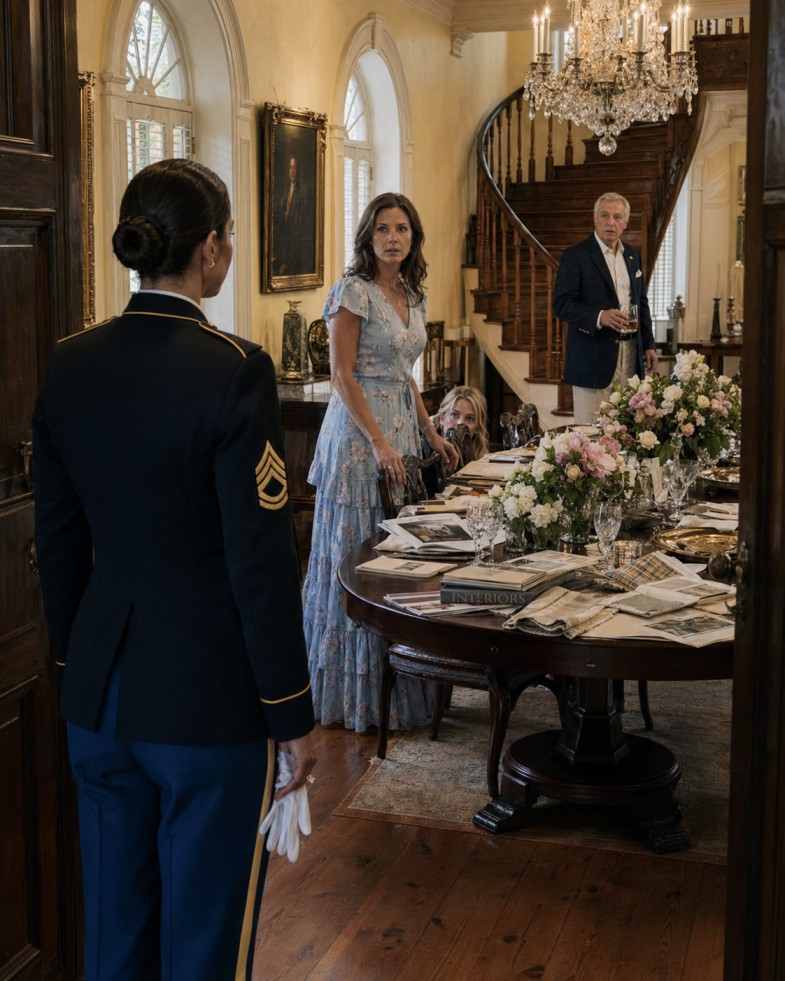
On Friday morning I put on my dress uniform.
Some people think uniforms are for other people.
Ceremonial.
Symbolic.
Meant to impress an audience.
They are wrong.
Sometimes a uniform is armor you put on to remind yourself who you became after surviving what should have ruined you.
We drove to the house just after noon.
Through the front windows, I could already see the performance underway.
Flower catalogs.
Guest lists.
Champagne glasses.
A wedding planner with swatches spread across my mother’s dining table.
Tiffany in ivory linen, laughing too loudly.
Janet at the center of it all, directing attention like she had been born inside those walls.
The butler opened the door.
Janet turned.
And her smile disappeared.
It wasn’t dramatic at first.
Just a flicker.
A brief collapse of the face she wore for other people.
Then she recovered enough to stand.
‘Rose,’ she said.
‘You didn’t need to come dressed like that.’
I stepped inside.
‘You asked
for signatures,’ I said.
‘I brought witnesses.’
Lawrence entered behind me.
Then Marjorie.
My father stood up so fast his chair scraped hard across the floor.
Tiffany’s expression changed from irritation to alarm.
She recognized Lawrence.
Whatever Janet had told everyone, this was no longer a private family discussion.
Janet tried first to laugh it off.
‘This is absurd,’ she said.
‘We’re only trying to simplify things.’
I set my phone on the dining table.
‘I agree,’ I said.
‘Let’s simplify them.’
Then I hit play.
Her own voice filled the room.
Sweet.
Confident.
Greedy.
Every word about taking my mother’s trust for Tiffany’s wedding.
Every insult about my service.
Every assumption that she had the authority to decide the fate of something that was never hers.
By the time the recording ended, nobody at that table looked comfortable.
The wedding planner stared at her swatches like she wanted to disappear.
Tiffany had gone white.
My father looked not shocked, but cornered.
Janet tried indignation next.
‘You recorded me?’
‘Yes,’ I said.
Lawrence laid a document on the table.
‘Mrs.
Owen,’ he said in the polite tone of a man delivering a controlled demolition, ‘your statements, combined with prior submissions bearing forged authorization, constitute sufficient cause to trigger the protective provisions of the Elizabeth Owen Trust.’
My father actually laughed once, disbelieving.
‘Protective provisions?’
Marjorie met his gaze.
‘Your late wife anticipated this exact scenario.’
Then Lawrence placed my mother’s sealed envelope in the center of the table.
My father’s face changed when he recognized the handwriting.
That part almost hurt more than anything.
Because for one second, before self-protection came back over him, I saw the man who had once loved her.
Lawrence opened the letter and read aloud.
My mother’s words were steady, intimate, and merciless in their clarity.
She wrote that love should never require surrendering self-respect.
She wrote that any person who tried to take from me under the language of family had already declared themselves my enemy.
She wrote that her home, her legacy, and her daughter were not to be used as consolation prizes for anyone else’s ambition.
Then came the legal execution.
Distribution of the trust was frozen pending formal review.
Recovery proceedings would be initiated on trust-linked assets improperly diverted.
My father’s occupancy protections under the Charleston property structure were terminated based on breach of condition.
Janet had no claim.
Tiffany had no claim.
And the house they had treated as their stage was no longer theirs to command.
Janet actually took a step back.
‘This is insane,’ she snapped.
‘This house is my home.’
Marjorie answered without emotion.
‘Legally, it is Rose Owen’s.’
Tiffany started crying first.
Not out of guilt.
Out of inconvenience.
‘Mom,’ she hissed, ‘what did you do?’
My father turned on Janet then, because cowards only become brave when they need another body to stand in front of blame.
‘You told me this was handled,’ he said.
Janet stared at him in disbelief.
Handled.
As if theft were a scheduling error.
I watched them unravel without interrupting.
That was the thing Janet had never understood about me.
She mistook quiet for weakness because noise was the only form of power she recognized.
When she finally looked at me, she tried one last version of the truth.
‘Rose,
sweetheart, this has gotten blown out of proportion.
We were trying to do something beautiful for Tiffany.
Family supports family.’
I looked at the flowers on the table.
The champagne.
The wedding binders spread over the wood my mother had polished with lemon oil.
Then I looked back at her.
‘My mother is not funding your performance,’ I said.
The room went very still.
Lawrence informed them that they would receive formal notice regarding timelines, inventories, and access restrictions.
Marjorie explained, in clear language even Janet could not twist, that any destruction, concealment, or removal of covered property from the house after that moment would deepen their liability.
The wedding planner quietly gathered her swatches and left without saying goodbye.
My father tried speaking to me once more before we walked out of the dining room.
‘Rose.’
Just my name.
No apology attached.
No accountability behind it.
I turned.
He looked older than he had on Tuesday.
For a second I wondered what he wanted.
Forgiveness? Rescue? A softer ending than he had earned?
What came out instead was, ‘You should have called Lawrence years ago if you had questions.’
Not I’m sorry.
Not I failed you.
Questions.
As if this had all happened because paperwork was confusing.
I felt something in me close completely.
‘I asked you to protect her memory,’ I said.
‘You wouldn’t even protect the silver.’
Then I left the room.
There was no triumph in it.
That surprised me.
I had imagined satisfaction.
Vindication.
Some dramatic sense of victory.
But walking through that house after the confrontation felt less like winning and more like excavating a grave that had never been allowed to settle.
I went upstairs alone.
In the attic storage room, behind boxes of Tiffany’s old decorations and Janet’s labeled plastic bins, I found three framed photographs of my mother wrapped in moving blankets.
Not broken.
Just hidden.
That somehow felt worse.
I carried them downstairs myself.
One of them was the portrait from our sailboat.
I set it in the foyer.
Janet watched me and said nothing.
By Monday, the locks had been changed under legal supervision.
Within three weeks, Janet and Tiffany were out.
My father left with them.
He sent a letter later, not handwritten, not brave, full of the vague language people use when they want absolution without confession.
I read it once and put it away.
There are injuries too old for dramatic closure.
Sometimes the cleanest ending is simply not handing someone another chance to edit the story in their favor.
The settlement took months.
Some money was recovered.
Some wasn’t.
The Mercedes stayed in dispute longer than it was worth emotionally, but the principle mattered.
Lawrence pushed where it counted.
Marjorie never softened when pressure came.
Janet learned the expensive lesson that entitlement sounds much uglier when it is transcribed.
As for me, I did not keep the Charleston house unchanged like a museum to pain.
I restored what mattered.
My mother’s photographs returned to the walls.
The dining table was refinished.
The porch swing Janet had thrown out was remade from old photos by a carpenter who remembered my mother.
I established a portion of the trust as a grant in Elizabeth Owen’s name for young women from military families entering college.
Another portion went
to ovarian cancer research.
Legacy is not just what you defend.
It is what you build forward so the dead are not only remembered for how they were lost.
Months later, I stood in the foyer in civilian clothes, holding the same yellowed envelope my mother had addressed to me.
I had read it many times by then, but one line still landed with the same force every time.
If they try to make you smaller, leave with your full height.
That was what Fort Sill had given me.
Not hardness.
Height.
Discipline.
A spine no one else got to bend for convenience.
Janet thought she was calling to take something from me that Tuesday afternoon.
She thought distance had weakened my claim.
She thought time had dulled my memory.
She thought the uniform meant I had become easier to command.
She never understood the opposite was true.
Time had shown me exactly who she was.
Distance had let me prepare.
And the uniform did not make me obedient.
It reminded me that under pressure, I do not break.
I execute.
My name is Rose Owen.
And the day my stepmother tried to turn my mother’s final gift into Tiffany’s wedding fund was the day she learned something I wish my father had learned sooner.
Love without respect is theft in softer clothing.
My mother left me more than money.
She left me instructions.
And this time, I followed them.