By the time the lawyer answered, I had stopped shaking.
Not because I was calm.
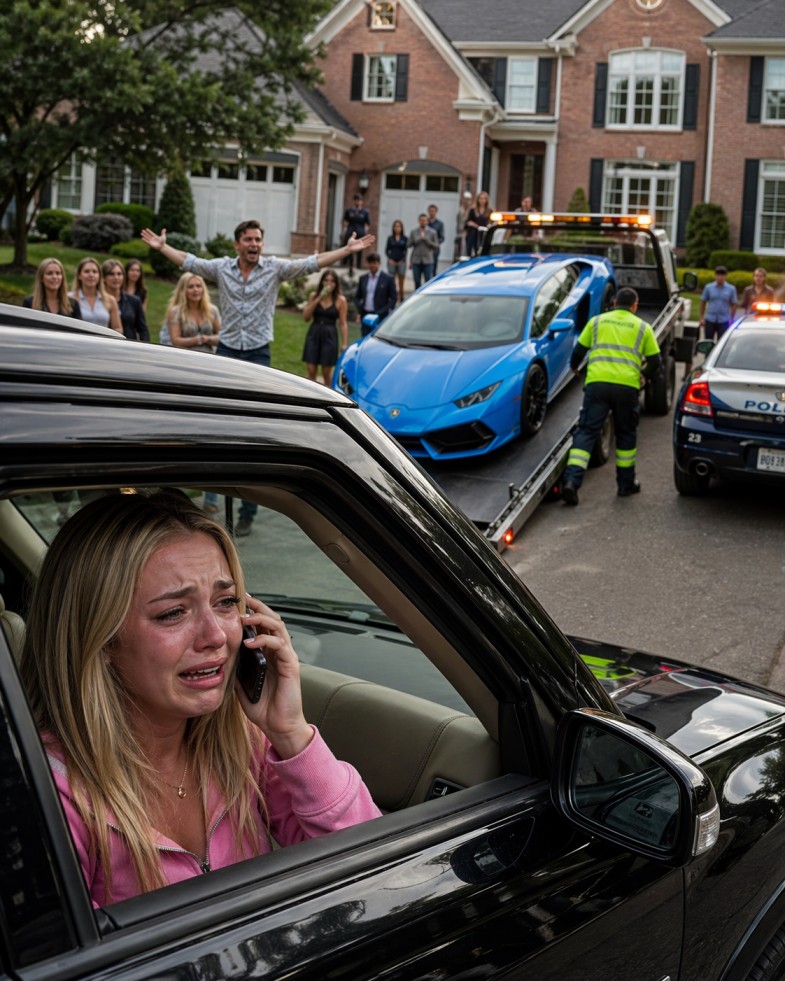
Because something colder had taken over.
“Patel & Greene,” a crisp female voice said. “This is Priya Patel.”
“My name is Elena Rivera,” I said, staring straight at my parents’ porch while Chloe twirled her car key around one finger like a trophy. “My husband was Staff Sergeant Marcus Rivera. He died three years ago. His life insurance was in a separate account for our son. I think my family just stole sixty thousand dollars from it.”
There was a beat of silence.
Then her voice changed.
Sharp. Focused. Dangerous.
“Are you in immediate physical danger?”
“No.”
“Is your child with you?”
“He’s inside their house.”
“Listen to me carefully, Elena. Do not argue. Do not accuse them of anything else. Go get your son. Leave. If anyone blocks you, call 911. Then come to my office first thing tomorrow morning with every document you have. Bank statements, insurance paperwork, IDs, everything.”
My father had stepped off the porch by then. His face had gone pale, but his voice was still hard.
“Hang up that phone,” he snapped. “Right now.”
I put the lawyer on speaker.
“Sir,” Ms. Patel said coolly, “if you interfere with my client taking her minor child and leaving, the next voice you hear will be law enforcement. I suggest you step away.”
My father froze.
For the first time in my life, he looked unsure of himself.
My mother set her glass down too carefully. “Elena,” she said in that syrupy tone she used when she wanted to sound reasonable, “you are making this uglier than it needs to be.”
I walked past her like she was a stranger.
Noah was in the living room on the rug with his toy dinosaurs. He looked up when I came in, his little face lighting up.
“Mommy!”
I dropped to my knees and hugged him so tightly he squeaked.
“Hey, baby.”
“Grandma said Aunt Chloe got a race car.”
I swallowed. “Did she?”
“Can we get pizza?”
My eyes burned, but the tears didn’t come back.
“Yeah,” I said, lifting him into my arms. “We can get pizza.”
Chloe appeared in the doorway, all perfume and smugness, her designer sunglasses pushed up into her hair.
“You’re really doing all this over a car?” she said. “God, Elena. You act like I murdered someone.”
Noah leaned his head on my shoulder.
I looked straight at her.
“No,” I said quietly. “You just spent the last thing my husband left for his son.”
For the first time, her smile slipped.
I carried Noah outside. My father moved like he wanted to block my path again, then thought better of it.
“Don’t do something stupid,” he muttered.
Too late, I thought.
All of you already had.
I buckled Noah into his car seat. Chloe clicked the remote and the sapphire-blue sports car flashed its lights behind me.
“Enjoy it,” I said, shutting Noah’s door.
She laughed a little too loudly. “Oh, I will.”
I looked at the car one last time.
“It won’t be yours for long.”
Then I got in my car and drove away.
I didn’t go home.
Ms. Patel had told me not to, not until we understood how deep the damage went. If my parents had access to one account, they could have access to more. So I drove to the apartment of my friend Tasha from work.
Tasha opened the door in scrubs and socks, took one look at my face, and didn’t ask a single question. She just moved aside and said, “Come in.”
Noah got his pizza. Tasha put on cartoons. I sat at her kitchen table with my laptop, my phone, and a numbness that felt almost holy.
The overdraft alerts kept coming.
Checking account.
Emergency savings.
A failed attempt on my debit card.
A pending wire.
My stomach dropped.
There should not have been a pending wire.
I logged into online banking with fingers that felt like ice. My password worked, but the security verification code didn’t go to my phone.
It went to an email address I didn’t recognize.
I stared at the screen.
Then I went into profile settings.
My trusted contact had been changed.
The backup email had been changed.
The mailing address had been altered to my parents’ house.
Not today.
Months ago.
I heard myself make a sound that didn’t even sound human.
Tasha came over immediately. “What?”
I turned the screen toward her.
Her face darkened. “Oh, hell no.”
There were transfers I had never noticed because I had been living shift to shift, checking balances, paying bills, surviving. Small ones at first. Two hundred dollars. Five hundred. A thousand labeled as “family support.” Then larger withdrawals. “Medical emergency.” “Home repairs.” “Tuition bridge.” Always just believable enough. Always framed like temporary borrowing.
It added up to almost thirty thousand dollars before the car.
My breath caught.
They hadn’t just stolen once.
They had been bleeding us for over a year.
Noah.
That money had been Noah’s.
Marcus’s last shield around him, peeled away one dishonest transfer at a time by the people who tucked Noah into bed when I worked nights.
I called the bank fraud line, then spent two hours freezing accounts, disputing transfers, changing passwords, placing alerts, answering security questions that suddenly felt like crimes.
Mother’s maiden name.
First pet.
Wedding date.
All things my family knew.
At 1:13 a.m., as Noah slept on Tasha’s couch with one sneaker still on, Ms. Patel emailed me.
Do not confront them further. Bring all insurance documents. Also bring any papers you signed after your husband’s death, even if you think they were unrelated.
I stared at that line for a long time.
Any papers you signed after your husband’s death.
A memory flickered.
My parents at my kitchen table after the funeral.
Casseroles on the counter.
Flowers dying in cloudy water.
My mother with a stack of forms and a pen.
Just sign here, honey. This one too. It’s all administrative. We’re helping you.
At the time, I had barely been able to remember my own name.
I had signed what they put in front of me.
Not blank pages, I told myself.
I would have noticed that.
Wouldn’t I?
I barely slept.
Ms. Patel’s office was on the third floor of a brick building downtown, above a dental practice and a tax accountant. She was younger than I expected, maybe early forties, with dark hair pulled back tight and eyes that missed nothing.
She did not waste time on sympathy.
She gave me coffee, a yellow legal pad, and instructions.
“Start from the beginning,” she said.
So I did.
Marcus.
The deployment.
The officers at my door.
The folded flag.
The insurance payout.
The promise I made to never use it except for Noah’s future.
My parents helping “temporarily” with paperwork while I drowned.
Chloe “borrowing” little things all her life and never returning them.
The sports car.
My mother’s smile on the porch.
When I finished, Ms. Patel tapped her pen against one document I had brought: the original account papers.
“Sole owner,” she said. “That’s good.”
“Good?” I laughed, hollow. “Sixty thousand dollars is gone.”
She met my eyes. “It’s good because it means no one had the right to access it without your express authorization. If they did, they either had a valid power of attorney… or they used fraud.”
Her assistant came in with a stack of records the bank had rushed over after her office sent an emergency request.
Ms. Patel started flipping through them.
Halfway through, she stopped.
Her face changed.
“What?” I whispered.
She turned one page toward me.
It was a power of attorney.
My name was typed neatly at the top.
My father’s name below it as my appointed financial agent.
My signature was at the bottom.
Or something that looked like it.
For one crazy second, doubt stabbed through me. Maybe I had signed it. Maybe grief had erased it.
Then I saw the date.
Seven months ago.
A date I remembered perfectly because Noah had had the flu that week and I had worked a double shift after sleeping two hours on the bathroom floor outside his room.
I had not signed anything seven months ago.
“That’s not mine,” I said.
“I know,” Ms. Patel said.
“How?”
She slid the page closer and pointed. “Your signature from your original account documents has a long upward tail on the last letter of your last name. This one doesn’t. Also, the notary stamp is smudged and the commission number is incomplete. Amateur work.”
I started shaking then, but this time it was fury.
“They forged it.”
“Yes.”
She pulled out another page.
And another.
And another.
A change-of-contact authorization.
A statement suppression request.
A form naming my father as an authorized in-person agent.
A request for a new debit card mailed to my parents’ address.
Every single one bore my forged signature.
Every single one had been accepted.
“How?” I whispered.
“Either the bank failed spectacularly,” Ms. Patel said, “or someone presented a very convincing story.”
She kept turning pages.
Then she went still again.
“What now?”
She didn’t answer right away.
Instead, she picked up her office phone and pressed a line.
“Janine, call County Clerk Family Division. I need verification on a case number.” She read the number off the page in front of her. “And put Detective Financial Crimes on my callback list.”
My mouth went dry.
“What case number?”
Ms. Patel handed me the document.
It looked official. A court header. A seal. A judge’s typed name.
Temporary Guardianship Petition: Minor Child Noah Rivera
My vision blurred.
Below it were statements attributed to my parents.
Mother works excessive hours and is emotionally unstable following husband’s death. Grandparents have served as de facto primary caretakers. Temporary financial and custodial protections requested in best interest of minor child.
There was even an attached “recommendation” on hospital letterhead claiming concerns about my ability to manage stress.
I stared at it.
“I never saw this.”
“I know.”
My voice broke on the last word. “What is this?”
Ms. Patel’s face was grim.
“This,” she said, “is not just theft. This is a plan.”
The room tilted.
My parents had not only stolen from me.
They had built a paper trail to paint me as unstable.
Unfit.
A widow too broken to keep her own child.
And if that fake guardianship had gone through—or even if they had used it to convince banks, schools, benefit offices, anyone at all—they could have taken far more than money.
They could have taken Noah.
Janine came back in ten minutes, pale.
“The clerk says that case number doesn’t exist.”
Silence dropped like a blade.
Ms. Patel nodded once. “That’s what I thought.”
She turned to me.
“Elena, someone forged a court document.”
I couldn’t breathe for a second.
Then the rage came back so strong it steadied me.
“What do we do?”
Her eyes hardened.
“Everything.”
The next six hours moved with terrifying speed.
Police report.
Fraud affidavit.
Emergency injunction.
Credit freeze.
Identity theft report.
A call to the Department of Veterans Affairs about survivor benefits.
A separate call regarding Noah’s dependent benefits.
And then, just when I thought I had already seen the worst of it, the credit report came back.
There was an account I didn’t recognize.
Then another.
One utility account in Noah’s name.
A high-limit credit card opened under my Social Security number with my parents’ address listed.
Two missed payments on a luxury auto insurance policy.
For Chloe’s sports car.
I laughed when I saw that.
Not because it was funny.
Because it was so obscene I could not process it any other way.
“They used my information to insure the car they stole from my dead husband’s fund to buy?” I asked.
“Yes,” Ms. Patel said.
“And Noah’s number?”
She took a breath.
“It appears they may have used his Social Security number as part of an identity verification chain. We’ll know more once the investigators subpoena the applications.”
I put a hand over my mouth.
My baby was four years old.
Four.
And they had already dragged his name into fraud.
My mother texted me just then.
I hope you’re proud of yourself. Chloe is hysterical.
Another message followed immediately.
You always did enjoy punishing people.
Then my father:
Call me before you ruin this family over a misunderstanding.
I handed the phone to Ms. Patel.
“Can I answer?”
She gave me a thin smile. “Not directly.”
She typed one email.
All further communication will go through counsel. Do not contact Ms. Rivera except regarding immediate logistical issues concerning her child, and only in writing. Preserve all documents, devices, and records. Destruction of evidence will be reported accordingly.
Then she hit send.
For the first time since the driveway, I felt something like air return to my lungs.
Not safety.
But alignment.
Truth finally had a shape.
The tow truck arrived at my parents’ house the next morning at 8:17 a.m.
I know the exact time because Chloe sent me a voice note shrieking so loudly my phone distorted.
“You psycho!” she screamed. “You had my car stolen!”
Not stolen.
Recovered.
The dealership had been notified that the purchase was funded through fraudulent transfers under active investigation. Their legal department moved fast once they heard the words forged power of attorney, disputed funds, and fake guardianship documents.
I didn’t answer the voice note.
But I did picture it.
The sapphire-blue car gleaming in the driveway.
Chloe running outside in silk pajamas.
Neighbors watching from behind curtains.
The hook lowering.
The front wheels lifting.
The whole shiny lie dragged away in daylight.
Tasha, standing beside me in her kitchen while I listened to the voicemail, let out a low whistle.
“Damn,” she said. “That must’ve been beautiful.”
“It was probably the first honest thing that car ever did,” I said.
Tasha stared at me, then grinned slowly. “There she is.”
“Who?”
“The version of you they should’ve been afraid of.”
I didn’t smile.
But I saved the voicemail.
Evidence.
Everything was evidence now.
My parents did not surrender gracefully.
By day three, they had switched tactics.
No more outrage.
Now they wanted pity.
My mother left a sobbing voicemail about her blood pressure.
My father wrote a four-page email about family loyalty, sacrifice, and how Marcus would be ashamed of me for involving police.
That one made my hands go cold.
Ashamed.
Marcus, who had slept on dirt halfway across the world and still called home to ask whether Noah liked the little stuffed dog he had mailed from base.
Marcus, who had kissed my forehead the night before deployment and whispered, “If anything happens, make sure they can never corner you.”
At the time I thought he meant bills. Stress. Loneliness.
I hadn’t realized he meant wolves who wore familiar faces.
Chloe went another direction entirely.
She showed up at Noah’s preschool.
Luckily, I had already warned them that no one but me or Tasha could pick him up.
The director called me immediately.
“There was a woman here claiming to be your sister,” she said carefully. “She had paperwork saying she was authorized for emergency pickup.”
My entire body went rigid.
“What paperwork?”
“She said there was a temporary custody arrangement due to your work schedule. We didn’t release him, of course, because it wasn’t on file and the situation felt… off.”
I had to sit down.
“She’s not authorized,” I said. “No one in my family is.”
When I got off the phone, Ms. Patel’s face was unreadable.
“She used the fake guardianship again,” I said.
“Yes.”
I felt sick.
“She tried to take my son.”
Ms. Patel didn’t soften her words.
“Yes.”
That attempt added another charge.
Attempted custodial interference.
It was no longer just financial fraud.
It was proof of intention.
They were not improvising.
They were executing a plan.
And I was done pretending otherwise.
A week later, Detective Ruiz asked me to come down to the station.
He was in his fifties, tired-eyed, and so direct I liked him immediately.
He spread photos across the table.
Bank security stills.
My father at the teller line.
Chloe beside him in oversized sunglasses, smiling at her phone.
My mother in the lobby chair holding a folder.
Another image from a different day showed my father presenting documents to an account specialist.
The timestamp was from two months earlier.
They had gone together.
Repeatedly.
Family field trips to rob a widow.
Ruiz slid another photo toward me.
A close-up of the notary stamp.
“We spoke to the notary,” he said.
My stomach twisted. “And?”
“She admitted she didn’t witness all the signatures. Said your mother is a friend from church and told her you were ‘too overwhelmed to come in.’”
I shut my eyes.
Of course.
My mother had always collected soft people the way some women collected teacups.
Ladies who volunteered. Ladies who brought casseroles. Ladies who would believe any lie wrapped in concern.
“She says she thought she was helping,” Ruiz added.
“She notarized fake powers of attorney and fake custody papers.”
His expression didn’t change. “Yes.”
I opened my eyes again. “Do you believe she didn’t know?”
He leaned back. “I believe people like your parents rely on everyone around them wanting conflict to disappear more than wanting truth to win.”
That sentence lived in me.
Because it was exactly right.
My parents had counted on discomfort.
Counted on shame.
Counted on me being too tired, too grieving, too polite to blow up the machinery.
What they never considered was what happens when the person carrying the family’s weight finally puts it down.
Ruiz tapped the last file.
“We also found a draft petition on your father’s laptop after the warrant. It wasn’t filed yet.”
My skin prickled.
“For what?”
He opened it.
Permanent guardianship.
Noah’s name was all over it.
So was mine.
Mother exhibits emotional volatility, poor financial judgment, and dependency on extended childcare support. Grandparents provide superior stability.
There were dates. Notes. Incidents twisted out of context.
The night I had a panic attack six months after Marcus died.
The month I took extra shifts and asked my mother to watch Noah more often.
A missed pediatric appointment I rescheduled the next day.
My grief.
My exhaustion.
My survival.
Documented like weaknesses to be exploited in court.
I touched the edge of the paper with one finger.
“They were collecting this for a case.”
“Yes.”
“So the car—”
Ruiz nodded. “Was not the beginning.”
No.
It was just the moment they got careless enough to flaunt it.
The plea offers came three months later.
Until then, the world split into two realities.
In one, I still worked the cafeteria line, refilled coffee urns, tied Noah’s shoes, signed preschool permission slips, and came home to a tiny apartment where every dollar mattered.
In the other, I sat in conference rooms with prosecutors and listened to strangers use words like conspiracy, forgery, theft by deception, financial exploitation, identity theft of a minor, attempted custodial interference.
Those words sounded like they belonged to newspaper stories.
Not to my mother.
Not to the woman who used to braid my hair before school.
Not to my father, who taught me how to drive in an empty church parking lot.
Not to Chloe, who once crawled into my bed after thunderstorms because she was afraid of lightning.
But memory is a dangerous liar.
People are not the softest thing they have ever done.
Sometimes they are the worst.
And sometimes the worst is the truest thing about them.
The prosecutor, a woman named Dana Mercer, laid out the options.
My father had been the architect. He forged signatures, managed the transfers, and drafted the guardianship documents.
My mother had provided access, emotional cover, childcare leverage, and false statements.
Chloe had knowingly spent the funds, used my information on financing and insurance documents, and attempted to use fake custody paperwork at Noah’s preschool.
“All three are asking for leniency,” Dana said.
“On what grounds?” I asked.
She looked unimpressed. “Family ties. No prior records. Claimed emotional motivations.”
I almost laughed.
Emotional motivations.
That was one way to describe greed wrapped in entitlement.
“What does leniency look like?” I asked.
“Reduced prison exposure if they plead out and cooperate. Full restitution orders. No contact provisions.”
I looked at the papers in front of me.
There was a time when the idea of sending my parents to prison would have shattered me.
But by then I understood something I hadn’t in that driveway.
I wasn’t doing this to them.
I was refusing to save them from what they had chosen.
“Will they still be felons?” I asked.
“Yes.”
“Will they still owe every cent back?”
“Yes.”
“Will there be no way for them to get near Noah?”
“If the judge accepts the terms, yes.”
I nodded once.
“Then take the plea.”
Ms. Patel glanced at me, measuring.
“You’re sure?”
I thought about the forged court seal.
The fake guardianship.
The attempt at preschool.
The way my mother had said, He was a hero, he’d want us to be happy.
“Yes,” I said. “I’m sure.”
The hearing was held on a gray Thursday morning that smelled like rain and courthouse disinfectant.
I wore my only black blazer.
Tasha sat behind me.
Ms. Patel on one side.
Prosecutor on the other.
Then they brought my family in.
Chloe looked smaller without the car and the attitude that came with it. My mother looked ten years older. My father still tried to stand straight, but there was something broken in the set of his mouth.
For a moment, old instinct flared.
The urge to ease things.
To fix it.
To be the strong one the way they had always defined it: absorb, endure, forgive, pay.
Then my eyes fell on the stack of evidence.
Noah’s name.
Marcus’s policy.
My forged signature.
The feeling passed.
One by one, they entered their pleas.
My father’s voice was hoarse when he admitted to fraud, forgery, and attempted unlawful interference with custody proceedings.
My mother cried through hers.
Chloe barely got the words out.
I did not look away from any of them.
Then came the victim statement.
I had written and rewritten mine ten times. In the end, I folded the paper in my hand and spoke without it.
“My husband died believing his family would be protected if he could not come home,” I said.
The courtroom was utterly still.
“The money you stole was not extra. It was not convenience. It was not a gift from the universe for you to use because I was too tired to notice. It was the last act of love from a man who knew he might die before he saw his son grow up.”
My voice didn’t shake.
“You did not just steal money. You stole safety. You stole trust. You took my grief, my long work hours, and my dependence on family childcare and tried to turn all of it into evidence that I didn’t deserve my own child.”
My mother began crying harder.
I did not stop.
“You called me dramatic. You told me to work extra shifts and earn it back. As if Marcus’s death was just another bill I should quietly cover because I am the reliable one.”
I looked at my father then.
“For years, I thought strength meant carrying people who hurt me. I was wrong. Strength is refusing to hand my son to the same people who would rob him and call it love.”
I turned toward the bench.
“I want the court to understand this clearly: if that sports car had never been parked in that driveway, they would have kept going. They would have emptied every account. They would have built every lie. They would have tried to take my son. And they would have expected me to apologize for stopping them.”
The judge’s face was stone.
When I sat down, Tasha squeezed my hand so hard it hurt.
I was grateful for the pain.
It proved I was still there.
Still real.
Still mine.
The judge accepted the plea agreements, but not gently.
He called my father’s conduct “calculated predation under cover of kinship.”
He called my mother’s actions “active facilitation disguised as maternal concern.”
He called Chloe’s behavior “willful participation fueled by greed and astonishing moral indifference.”
Then he sentenced them.
My father received prison time.
My mother received prison time, shorter but real.
Chloe received prison time followed by probation, mandatory restitution, and a permanent no-contact order regarding Noah unless a court later determined otherwise—which, given the record, would never happen.
The courtroom gasped softly when the sentences were read.
I didn’t.
Because by then the real sentence had already landed.
They had lost the only daughter who ever kept their chaos from swallowing them.
They had lost the grandson they tried to turn into leverage.
They had lost the right to call what they did a family matter.
As deputies moved them out, my mother twisted around and looked at me with a face I had seen all my life whenever consequences finally found her.
Not guilt.
Not remorse.
Injury.
How could you let this happen to me?
I held her gaze and gave her the one thing I had never been allowed to give before.
Nothing.
No reassurance.
No rescue.
No softening.
Nothing.
Chloe was crying openly now. “Elena,” she choked out. “Please.”
I said nothing.
My father didn’t look back at all.
That was fine.
Cowards prefer walls.
Justice did not fix everything overnight.
I wish it had.
I wish the bank restored all the funds immediately and the trauma vanished and Noah forgot the tension in my shoulders whenever an unknown number called my phone.
But real endings are built, not handed over.
There were months of paperwork.
The bank eventually accepted liability for failing to catch forged documents and reimbursed a significant portion of the stolen money. The dealership unwound the purchase entirely. The fraudulent credit lines were closed. Noah’s credit was locked down. The benefits offices corrected the records.
My parents’ house was sold to satisfy restitution.
My mother’s jewelry disappeared into evidence inventories and auction lots.
My father’s retirement account was gutted.
Chloe’s internship evaporated the moment the charges became public record. So did every glamorous little future she had assumed would simply appear because consequences were for other people.
Some nights, after Noah went to bed, I sat at my tiny kitchen table and shook all over again.
Not from grief.
Not exactly.
From the delayed aftershock of understanding how close I had come to losing everything while calling it help.
I started therapy.
Real therapy, with a woman who did not tell me to “move on” or “keep the peace” or “be the bigger person.”
She said things like, “You were conditioned to confuse usefulness with love,” and “Boundaries feel cruel only to people who benefited from your lack of them.”
I wrote those down.
I lived by them.
Tasha helped me apartment hunt.
Ms. Patel helped me set up an actual trust for Noah, ironclad and professionally monitored this time.
Dana Mercer checked in once, months later, just to tell me the no-contact order had been fully entered and there had been no successful attempts to challenge it.
And Noah—
Noah kept growing.
Children are miraculous that way.
He learned to zip his own jacket.
He learned to write the letter N.
He learned that Mommy’s tired face in the evening didn’t mean danger, just long days.
One night while I tucked him in, he asked, “Are Grandma and Grandpa still in time-out?”
I sat on the edge of his bed and smoothed his hair back.
“Yes,” I said carefully.
“Because they were mean?”
“Yes.”
He thought about that.
“Forever?”
I looked at him, at Marcus’s eyes in that small solemn face, and chose the truth in the only shape a child could carry.
“Some people are not safe, even if they’re family,” I said. “So we stay away from them.”
He nodded once, satisfied.
Then he held up his stuffed dinosaur.
“Rex says that’s a good rule.”
I laughed.
Really laughed.
The sound startled me.
It had been a long time.
A year after the sentencing, I took Noah to the cemetery.
The spring grass was bright and the sky was that impossible clear blue Marcus used to call deployment weather.
Noah carried a small toy truck in one hand and a flower in the other. He set the flower carefully at the base of Marcus’s headstone, then leaned against my leg.
“Hi, Daddy,” he said.
My throat tightened.
I knelt beside him and touched the engraved letters of Marcus’s name.
Staff Sergeant Marcus Rivera.
Beloved husband.
Devoted father.
I used to come here and apologize.
For surviving badly.
For being tired.
For not being enough.
That day, I brought something else.
I took an envelope from my bag and laid it at the base of the stone.
Inside was a copy of Noah’s new trust statement.
Restored. Protected. Growing again.
Not because the world had suddenly become kind.
Because I had finally become unbreakable in the right direction.
“I kept my promise,” I whispered.
The wind moved softly through the trees.
Noah looked up at me. “What promise?”
I swallowed and smiled at him.
“That I’d take care of us.”
He considered that, then nodded like it was obvious.
Because to him, maybe it was.
Children don’t always see the battlefield.
Sometimes they only see who came home standing.
We stayed there a while longer. Noah rolled his truck through the grass, making soft engine noises. I sat beside Marcus’s grave and let the sunlight warm my face.
I thought about the woman in the driveway, phone in hand, tears drying on her cheeks while her family mistook her silence for surrender.
I wanted to reach back through time and tell her this:
You are not cruel for ending the theft.
You are not selfish for choosing your son over your parents.
You are not weak because grief made you vulnerable.
And you are not dramatic for refusing to let the people who wounded you also write the story of what happened.
When Noah was ready to leave, he slipped his hand into mine.
As we walked back to the car, he looked up and asked, “Mommy?”
“Yeah, baby?”
“Were you scared?”
I looked at him honestly.
“Yes.”
He squeezed my fingers. “But you did it anyway.”
I smiled down at him.
“Yes,” I said. “I did.”
He seemed to think that over very seriously.
Then he announced, “That means you’re brave.”
Maybe I was.
Maybe bravery wasn’t a grand thing after all.
Maybe it was just the moment you stopped letting pain teach you obedience.
Maybe it was calling the lawyer.
Maybe it was saying no.
Maybe it was understanding that love without safety is not love, and family without honesty is just a trap with shared DNA.
At the car, I buckled Noah in, shut the door, and looked up at the sky one last time.
Marcus was gone.
That would never stop hurting.
But the thing my family failed to understand was this:
His death had not left me helpless.
It had left me responsible.
And once I remembered that, they were finished.
I got into the driver’s seat and started the engine.
The account was restored.
The trust was protected.
The charges were final.
The no-contact orders were in place.
The car was gone.
The lies were on the record.
My son was safe.
That was the ending.
Not forgiveness.
Not reconciliation.
Not one last tearful holiday where everyone learned a lesson and passed the potatoes.
This.
A clean break.
A locked door.
A child who would grow up knowing that being loved did not mean being used.
As I pulled away, sunlight flashed across the windshield so brightly I had to squint.
For a second, it felt almost like a blessing.
And maybe it was.
Because in the end, I didn’t send them to hell.
They built it themselves, piece by piece, with greed and lies and entitlement.
I just stopped going down with them.