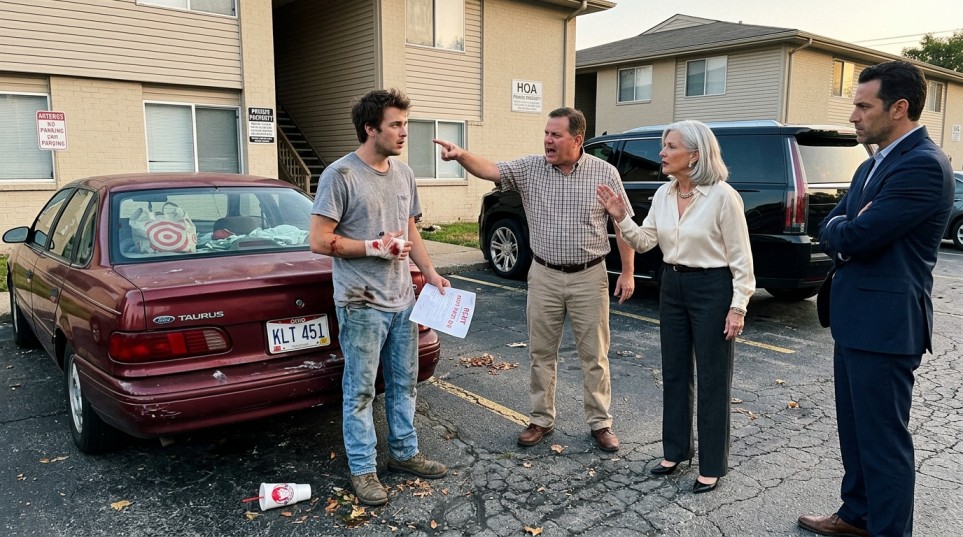
I was on my way home from a double shift when I saw her.
It was one of those ugly Texas evenings where the sky turns yellow-gray, the air feels like wet concrete, and everybody’s in a bad mood. My old Ford was coughing like it wanted to die right there at the red light outside a gas station that smelled like burnt coffee and tire rubber.
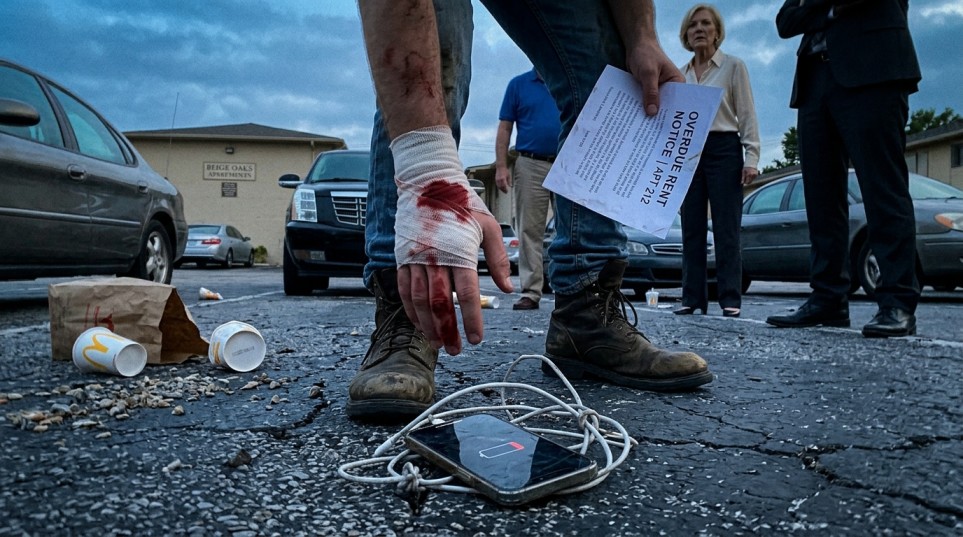
I had $14.23 in my checking account.
Not “I’m broke” in a funny way. I mean actually broke. Rent was late. My phone bill was two days from shutoff. My fridge back at my apartment had half a bottle of ketchup, a pack of cheap hot dogs, and baking soda I didn’t even remember buying.
That was my life.
So when I saw this older woman standing beside a black SUV with a flat tire, I almost kept driving. Almost.
She didn’t look helpless at first. She looked irritated. The kind of irritated you get when life usually obeys you and suddenly it doesn’t. Her blouse was wrinkled with sweat. Her hands were shaking while she stared at her phone like it had personally betrayed her.
Cars kept flying past.
Nobody stopped.
I don’t know why I pulled over. Maybe because my mom raised me to believe that if somebody’s stranded on the side of the road, you help. Maybe because I know what it feels like when the whole world looks right through you.
She looked me up and down when I walked over. I could see the hesitation in her face. Cheap work boots. Faded jeans. Grease under my nails. I knew exactly what she saw.
Still, I asked if she needed help.
She said her roadside app wasn’t working, her battery was dying, and she had someplace “important” to be. Her voice had that tight, polished sound rich people have when they’re trying not to panic in public.
I changed the tire with my work shirt wrapped around my hand because the jack was rusted and sliced my palm open.
She offered me money.
I told her no.
Not because I’m some saint. I just didn’t want her looking at me like I was waiting for a payout. I said, “Just get home safe. That’s enough.”
She stared at me for a second too long after that.
Then she asked my name.
The next morning, my landlord was pounding on my apartment door so hard the wall art shook. I thought it was about the rent.
It wasn’t.
Because standing in the parking lot behind him… right beside a black Escalade and two men in suits… was the same woman.
And the first thing she said made my blood run cold.
She looked me dead in the face and said, “You have no idea who I am, do you?”
Part 2: The Woman in the Parking Lot
My mouth went dry.
I stood there barefoot in gym shorts and an old Walmart T-shirt, hair a mess, one eye still half-shut from sleep. The landlord, Gary, smelled like stale cologne and cheap coffee. He had that smug look he always wore when he thought life had finally cornered me.
Usually when he showed up, it meant trouble.
A late fee.
A warning.
Another speech about “adults needing to take responsibility.”
I hated that man.
But that morning he looked nervous.
Not angry. Nervous.
That got my attention fast.
The woman stepped closer. In daylight she looked even more put together than I remembered. Not flashy. Not loud. Just expensive in a way that whispered instead of shouted. Her earrings were simple. Her watch probably cost more than my car. Her hair was pulled back, and there was something in her expression I couldn’t read.
One of the men in suits stayed by the Escalade.
The other handed her a leather folder.
She ignored it.
“I’m sorry for showing up like this,” she said.
That was the first weird thing.
Rich people don’t usually apologize to guys like me.
Gary cleared his throat and said, “Mr. Carter, maybe you should hear her out.”
Mr. Carter.
He had never called me mister in his life.
My stomach tightened.
The woman asked if we could talk somewhere private. I glanced back into my apartment and wanted to laugh. Private? My apartment looked like a goodwill donation bin lost a fight. The couch had duct tape on one arm. The sink was full of dishes. The AC made a grinding sound every ten minutes like it was chewing nails.
Still, I let them in.
She stood in the middle of my living room and looked around, taking in everything. The torn blinds. The unpaid electric bill on the table. The ramen cups lined beside the trash can because I’d been too cheap to buy real groceries.
I felt exposed.
Not poor in a vague way. Poor in a fluorescent, humiliating way.
She noticed the bandage on my hand.
“You should’ve gotten stitches,” she said quietly.
I shrugged. “Couldn’t afford the urgent care copay.”
That landed heavier than I meant it to.
For a second, nobody spoke.
Then she introduced herself.
Her name was Evelyn Mercer.
I didn’t react.
Why would I?
She watched my face, almost waiting for it.
Then one of the suited men finally spoke. “Ms. Mercer is the founder and CEO of Mercer Hospitality Group.”
Still nothing.
Then he added, “She owns eleven hotels, four senior living properties, a private investment firm, and several commercial developments in Texas, Oklahoma, and Arizona.”
I remember blinking once.
Maybe twice.
Because that name finally hit.
Mercer.
Even I knew it.
You see names like that on downtown buildings. On charity galas in the news. On those giant checks people hold for hospital donations while smiling like they invented kindness.
I looked at her, then at my apartment, then back at her.
“You’re kidding.”
“I’m not,” she said.
The room felt smaller.
Gary suddenly found the floor fascinating.
I asked the only thing I could think of.
“Why are you here?”
She took a breath. A real one. Deep enough to move her shoulders.
Then she said something I still think about.
“Because I needed to know whether a man who had almost nothing would still do the right thing when nobody was watching.”
I frowned. “What?”
She opened the leather folder.
Inside were pictures.
Photos of the gas station.
My Ford at the curb.
Me kneeling beside her SUV.
My blood on the rag.
A cold wave went through me.
“What is this?”
Her face tightened. “Security. Mine.”
I felt heat rise in my chest.
“So you had people watching me?”
“No. They were following me.”
That was not better.
I stepped back. “Why were people following you?”
She hesitated long enough for me to know the truth was ugly.
Then she told me.
Her son had been pushing to declare her medically unfit to lead her company.
Her own son.
He’d been building a case that she was “slipping.” Forgetful. Emotional. Unstable. Too old to stay in control. If the board agreed, he would step in, take over operations, and effectively sideline her while keeping her name on the letterhead.
I stared at her.
She continued in a voice so flat it scared me. “Yesterday I left a board dinner early after hearing things I was never supposed to hear. I drove off upset. My driver was dismissed. My phone was nearly dead. And when the tire blew, I realized something I never thought I’d have to admit.”
She looked around my apartment again.
“I had money. Influence. Staff. Lawyers. Cars. Security. But at that moment, I had no one.”
I didn’t know what to say.
She told me her son’s team had indeed been tracking her movements “for safety,” which in rich-people language apparently means control. The photos had been sent to her office overnight. That’s how she found my name from the gas station surveillance, my license plate, and eventually my address.
I should’ve been furious.
Part of me was.
But another part of me saw something in her face that didn’t look powerful at all. It looked tired. Like somebody who’d spent a lifetime climbing only to find no real hands waiting at the top.
Then she made me an offer.
And it was so insane, I actually laughed.
She wanted to hire me.
Not as a driver.
Not as security.
As a personal assistant for thirty days.
I laughed again. “Ma’am, I stock warehouse inventory and unload trucks.”
She said, “Then you know how to work.”
I said, “I don’t know anything about billion-dollar companies.”
She corrected me. “Millionaire. And I’m not asking you to run my company. I’m asking you to help me remember what honesty looks like.”
That line stuck in my ribs.
Still, I said no.
Fast.
Because people like me don’t get mysterious offers from women like her without strings attached.
I had been poor long enough to know that when rich people say “trust me,” it usually ends with somebody else paying the bill.
But then Gary spoke up.
And what he said changed everything.
“Jake,” he muttered, refusing to meet my eyes, “your rent’s already been covered for the next six months.”
The room went dead silent.
I turned so fast my bandaged hand smacked the table.
“What?”
Gary swallowed. “She paid it this morning.”
I looked at Evelyn.
My ears were ringing.
“I didn’t ask for that.”
“I know,” she said.
“I can’t repay that.”
“I didn’t do it for repayment.”
I should’ve thrown them out.
I should’ve told them all to get lost.
Instead, I sat down on my taped-up couch, stared at the stained carpet, and realized for the first time in months that I could breathe all the way into my lungs.
That scared me more than anything.
Because hope is dangerous when you’ve been broke a long time.
Part 3: The Quiet Way People Prepare for War
I told her I’d do it for one week.
Not thirty days.
One week.
She agreed too quickly, which should’ve been another warning sign.
By Monday morning, I was sitting in the back of a black SUV wearing the only button-down shirt I owned, bought three years earlier for a cousin’s funeral. It barely fit across the shoulders. Evelyn glanced at it and said nothing, but an hour later a tailor met us at her office.
That was the first time I’d ever been measured for clothes.
I didn’t enjoy it.
It felt like being remodeled for someone else’s world.
Her headquarters sat in a glass building downtown where everything smelled like lemon polish and money. Women in heels moved fast without sweating. Men in suits smiled with their mouths, not their eyes. The coffee machines looked more advanced than my car engine.
Everybody stared at me.
Not openly. Politely.
Which somehow felt worse.
Evelyn didn’t introduce me with some fake title. She simply said, “This is Jake. He’s with me.”
And that was enough.
I followed her into meetings and took notes. At first, I barely understood half of what people were saying. EBITDA. Asset exposure. restructuring. fiduciary language. It sounded like a foreign dialect built from polished knives.
But after a few days, I started noticing something.
Rich people lie softer than poor people.
That’s the difference.
Where I come from, lies are loud. Slamming doors. Missed payments. “I’m good for it, I swear.” “Just spot me till Friday.” “I didn’t take it.”
In Evelyn’s world, lies wore cufflinks.
They smiled.
They praised you before cutting your legs out.
Her son, Daniel, was the worst of all.
He was handsome in that TV-lawyer way that made people trust him too fast. Firm handshake. Calm voice. Expensive haircut. He called her “Mother” in meetings, like every syllable had been scrubbed clean.
The first time he met me, he smiled and asked, “And what exactly is it you do for her?”
I said, “Whatever she needs.”
He smiled wider. “Interesting.”
That one word felt like a slap.
He underestimated me immediately, which turned out to be his mistake.
I’m invisible to people like Daniel. Men who’ve never had their debit card declined in public don’t know how little they notice the working poor. They talk around us. In front of us. Like we’re furniture with pulse.
So I listened.
And what I heard made my skin go cold.
Daniel had been talking to board members privately.
Not just about his mother’s health, but about “repositioning the brand.” Which meant younger leadership, cost-cutting, asset liquidation, and one particularly ugly phrase I found in a printed memo left in a conference room: legacy displacement strategy.
Legacy displacement.
That’s what they called pushing his own mother aside.
Like she was old office furniture.
Evelyn didn’t react much when I told her. She just nodded once, slow and tired, like I’d confirmed something she already knew in her bones.
That night, she invited me to dinner at her home.
Calling it a home feels stupid now. It was an estate. Gates. Stone driveway. Landscaping so perfect it looked fake. Inside, everything was quiet in a way that made you lower your voice automatically.
But the dining room told the truth.
A table for twelve.
Two place settings.
She lived alone.
Halfway through dinner, she put down her fork and said, “Do you know the first time my son lied to me?”
I shook my head.
“He was eight. He stole twenty dollars from my wallet and blamed the housekeeper.”
She smiled then, but it was the saddest smile I’d ever seen.
“I knew he did it. I said nothing because I thought shame would teach him what punishment couldn’t.”
She looked at the untouched wine in her glass.
“It didn’t.”
That’s when I understood this wasn’t just business.
This was rot.
Family rot.
The kind that starts small and smells normal until one day the whole house is poisoned.
The next week, things escalated.
Her emails were being forwarded.
Documents disappeared.
A private doctor’s evaluation appeared on the board agenda even though she never approved one.
And then came the final insult.
Daniel scheduled a “wellness review” in front of senior leadership.
A public humiliation dressed up as concern.
He wanted her rattled. Emotional. Defensive.
Old.
He wanted the room to see weakness.
Evelyn read the schedule and said only one thing.
“Good.”
I stared at her. “Good?”
She stood from her desk, walked to the window, and looked down at the city glowing below.
Then she said, “If a snake insists on coming into the light, let him.”
That was the moment everything shifted.
She was done surviving.
Now she was preparing.
Quietly.
Carefully.
The lawyers came first.
Then forensic accountants.
Then archived emails were pulled.
Phone records.
Internal recordings.
I spent three straight nights beside her general counsel in a conference room lit by vending-machine coffee and laptop glare. We built folders. Timelines. Names. Transfers. Hidden shell arrangements. Votes promised before meetings had even happened.
Daniel hadn’t just tried to remove his mother.
He’d been positioning himself to profit from a manipulated stock move after announcing a dramatic leadership transition.
It was slick.
It was planned.
And it was filth.
The craziest part?
Without meaning to, I found the piece that cracked it open.
A cleaning woman was emptying a trash bin outside one of the executive offices when I saw a torn sheet with Daniel’s handwriting on it. Most people would’ve ignored it.
I didn’t.
Poor people notice scraps. We live by what others throw away.
I pieced it together on the conference table like a ransom note. Dates. Percentages. A meeting location. A phrase: after physician statement is public.
That scrap led to a private email account.
That email account led to one outside consultant.
And that consultant led to proof.
By the time the board meeting arrived, Evelyn was no longer cornered.
She was loaded for war.
Part 4: The Day the Masks Came Off
The boardroom was freezing.
That fake corporate cold that keeps everybody alert and uncomfortable.
I stood against the back wall while directors filed in carrying tablets, coffee, and the kind of expensive stress that leaves no wrinkles. Daniel arrived last, all confidence and polished concern.
He kissed Evelyn on the cheek.
I watched her not flinch.
“Mother,” he said softly, “you look tired.”
She smiled.
“So do you, Daniel.”
The meeting began with numbers, updates, routine approvals.
Then came the item he had been waiting for.
“Leadership continuity and wellness review.”
He said it gently, like a son worried about his mother.
That almost made it worse.
He stood and spoke with practiced sadness. Mentioned pressure. Demands. The need for stability. The importance of protecting the company from uncertainty. Then he shifted into concern for Evelyn’s “recent lapses,” “erratic choices,” and “concerning judgment.”
He even referenced the roadside incident.
I felt my jaw lock.
He said her behavior that evening suggested distress, disorientation, and “potential executive impairment.”
For a second, the room was still.
Then he played his card.
A physician’s preliminary statement.
Or what he thought was one.
Evelyn glanced at general counsel.
Counsel nodded.
And Evelyn stood up.
Not fast.
Not dramatic.
Just steady.
“Before we continue,” she said, “I’d like to clarify something.”
Daniel smiled politely, the way people smile when they think the ending is already written.
Then Evelyn pressed a button on the conference phone.
The screen changed.
An email chain appeared.
Then another.
Then a bank transfer record.
Then meeting notes.
Then the torn handwritten page, reconstructed and enlarged.
The room shifted.
You could feel it.
Like oxygen changing before a storm.
Daniel’s smile cracked first.
“What is this?” he snapped.
His mother looked at him with a calm so cold it made my spine tingle.
“This,” she said, “is what betrayal looks like when printed.”
One by one, the evidence hit the room.
His coordination with outside advisors.
His attempts to pressure a physician.
His early discussions of asset sales tied to leadership change.
His back-channel promises to certain board members.
And finally, the outside consultant on video, in a deposition recorded the previous evening, explaining exactly how Daniel intended to use public concern over his mother’s health to force a transition and personally profit from the fallout.
No one moved.
No one breathed.
Daniel went pale.
Then red.
Then mean.
He slammed both hands on the conference table and turned to Evelyn with his face stripped clean of polish.
“You should have stepped aside years ago!”
There it was.
Not concern.
Not strategy.
Hunger.
Raw and ugly.
“You built all this,” he hissed, “and you were going to let it die with you out of pride.”
Evelyn’s voice stayed level.
“No, Daniel. I was going to leave it to someone with character.”
He laughed once. Sharp and humorless.
“And instead you brought him?” He jabbed a finger at me. “A warehouse nobody from the side of the road?”
Every eye in the room turned toward me.
My ears burned.
I started to look down.
Then I remembered every night I’d eaten noodles in the dark because I was too tired to pretend life wasn’t crushing me. Every sneer. Every dismissal. Every time men like him looked straight through me.
So I didn’t look down.
I looked right back at him.
And for the first time in my life, I understood something.
A person like Daniel doesn’t hate the poor because we’re weak.
He hates us because sometimes, despite everything, we still know the value of things money can’t buy.
Evelyn answered for me.
“Yes,” she said. “I brought the man who helped a stranger when he thought she had nothing to offer him. That man has more integrity in his injured hand than you’ve shown in your entire body.”
The silence after that hit like a gunshot.
One director removed his glasses.
Another leaned back and whispered, “My God.”
Daniel started talking fast then. Denials. Context. Misunderstandings. Selective interpretations. Legal threats.
It didn’t matter.
The vote was called.
Not against Evelyn.
Against him.
Immediate suspension pending full investigation. Removal from transition planning. Freeze on related authorities. Independent review.
Passed.
Not narrowly.
Overwhelmingly.
Daniel looked around the room like he’d entered the wrong universe.
Then security came.
Not the dramatic kind with wrestling moves and shouting. Just two quiet men at the door waiting for him to realize the meeting was over and so was the version of himself he had counted on.
He looked at his mother one last time.
She didn’t smile.
She didn’t cry.
She just said, “You mistook access for love. That was your final mistake.”
And he walked out.
Just like that.
The room stayed silent long after the doors closed.
Then Evelyn sat down slowly, like the weight of ten years had finally landed all at once.
I moved toward her without thinking.
She looked up at me, eyes glassy but fierce.
And under her breath, so only I could hear, she said, “Thank you for stopping your car.”
Conclusion: What Karma Looked Like Up Close
People always imagine karma as fireworks.
A public collapse.
A screaming apology.
A perfect movie ending.
It isn’t.
Karma is quieter than that.
Sometimes it looks like an old woman walking back into her own boardroom with the truth in both hands.
Sometimes it looks like a son learning too late that intelligence without decency is just another form of stupidity.
And sometimes it looks like a broke man realizing his life did not end in that apartment complex just because the world acted like it had.
I stayed on with Evelyn after that.
Not because she “saved” me.
I need to be clear about that.
She didn’t rescue me like some fairy tale rich lady tossing coins from a balcony.
She did something stranger and more meaningful.
She saw me.
A few weeks after the boardroom showdown, she asked me what I wanted to do with my life if fear and money weren’t deciding for me.
Nobody had ever asked me that before.
Not really.
I told her the truth.
I wanted to build something of my own someday. Not a giant company. Just something solid. Honest. Maybe logistics. Maybe fleet services. Something blue-collar and dependable. Something that treated workers like human beings instead of replaceable parts.
She nodded like she’d been waiting for that answer.
Months later, with contracts, lawyers, and more caution than pride, she became my first investor.
Not a handout.
An investment.
The difference matters.
I moved out of that apartment.
Paid every dollar of rent myself after the first six months.
Bought groceries without checking my account three times first.
Fixed my credit.
Called my mother and told her I was okay before she could hear the strain in my voice and pretend not to.
And every once in a while, when I drive past that gas station at dusk and the sky turns that same dirty yellow-gray, I think about how close I came to not stopping.
How easy it would’ve been to keep driving.
How normal.
How understandable.
And how that one decent choice, made on the worst week of my life, opened a door I never knew existed.
People online love saying kindness always comes back.
That isn’t true.
A lot of kind people get stepped on every day.
A lot of good deeds go unseen.
But sometimes, just sometimes, the world is watching in ways you don’t understand yet.
Sometimes the stranger on the roadside is carrying more than a flat tire.
Sometimes the rich woman in distress is lonelier than the broke man helping her.
And sometimes the one thing that separates a decent life from a ruined one is a decision made in thirty dirty, inconvenient minutes beside a highway.
I was a poor young man with a bleeding hand, a dying Ford, and fourteen dollars to my name.
She was a powerful millionaire with nobody she could trust.
For one strange night, we were just two people stranded in different ways.
And that turned out to be enough.