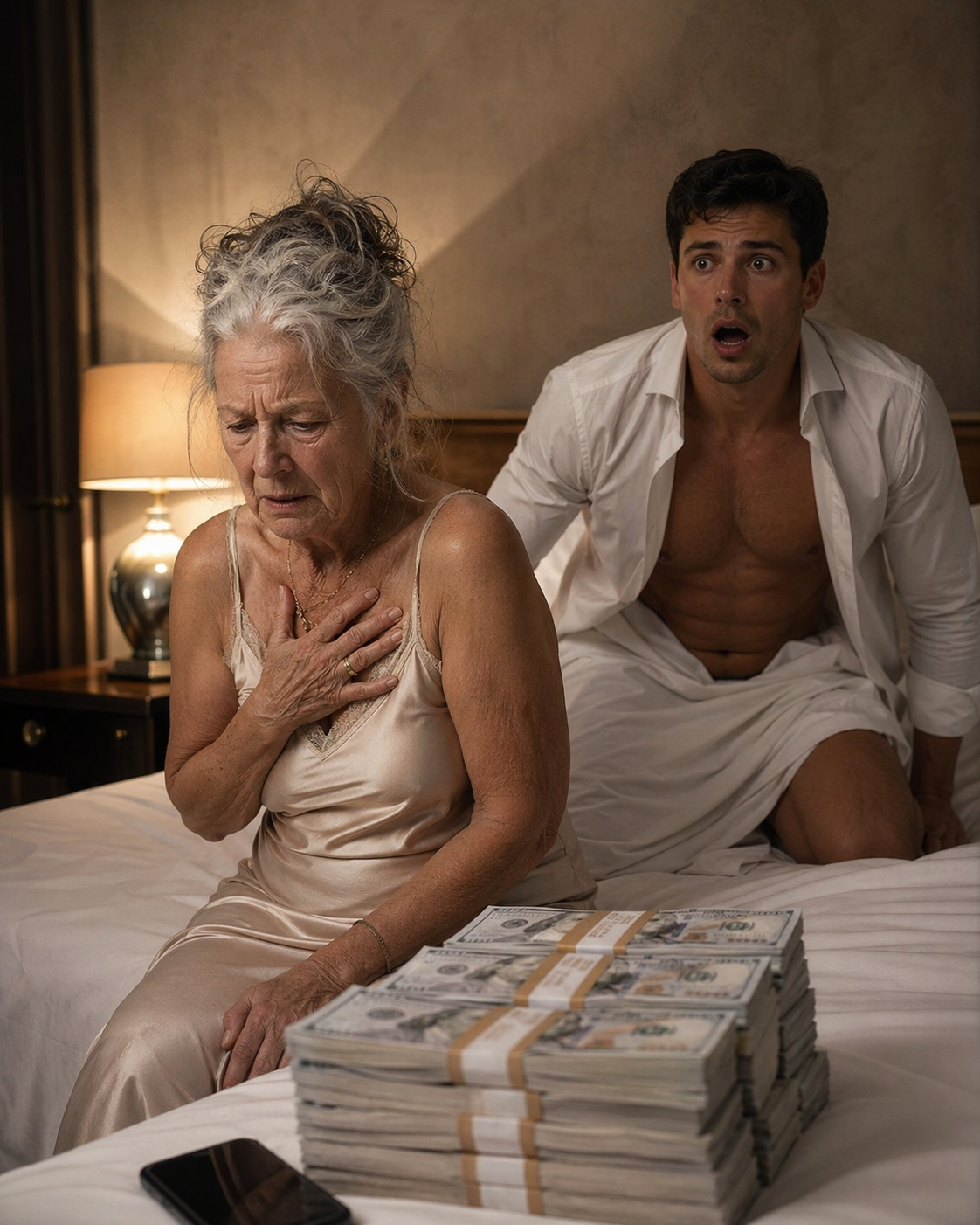
“You’d rather marry a sixty-year-old woman than find a decent girl your own age.”
That was what my mother shouted at me in the middle of our dusty front yard—loud enough for my uncles, the curious neighbors, and even the propane delivery man to hear every word.
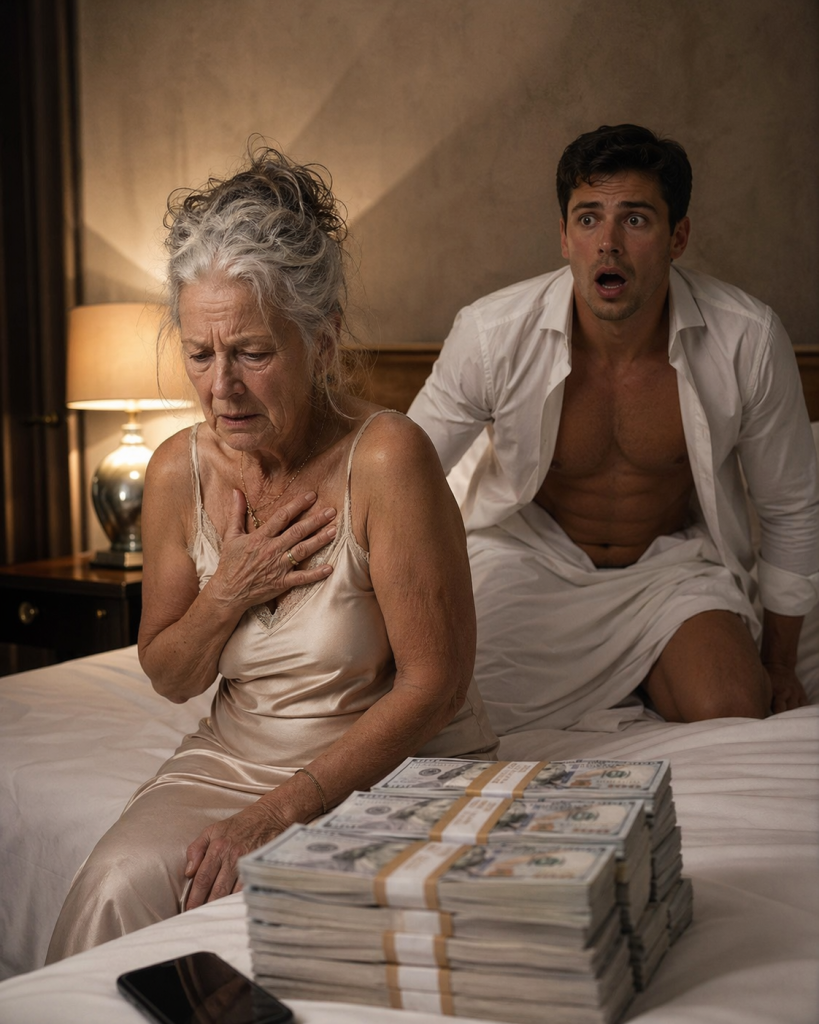
My name is Travis Miller. I’m twenty years old, tall, broad-shouldered, and from a small rural town in eastern Kentucky, where rumors travel faster than the wind and settle long before the truth ever gets a chance to stand.
At my age, most of my friends were chasing cheap thrills—dirt bikes, beer runs, and high school romances that never lasted past the summer.
Me?
I had become the center of every whisper in town because I had decided to marry a woman named Eleanor Brooks.
People called her Miss Eleanor—not because she was frail or weak, but because she carried herself with the kind of quiet authority that made other people lower their voices when she entered a room.
She dressed with simple elegance, spoke in calm, measured tones, and looked at people as if she truly saw them instead of judging them from a distance. She had money, yes, but she never used it to humiliate anyone or prove a point.
I met her while repairing a broken fence on property she had recently purchased outside town. When I burned my hand with a welding torch and the other men nearby laughed at my clumsiness, she was the only one who stepped forward—with water, ointment, and a quiet kindness that caught me completely off guard.
From that day on, she treated me differently than anyone ever had.
She lent me books on business and personal growth—books I struggled through at first, but refused to give up on. She corrected my English gently, never making me feel small. She talked to me about saving money, building something meaningful, and imagining a future bigger than the workshop, the debts, and the dry fields around our house.
No one my age had ever made me believe my life could stretch beyond the limits of that town.
Because of her, I started to believe I could become more than what I had always been told I was.
And yes—I fell in love with her.
Not because of her money.
Not because of comfort.
Not because of appearances.
I fell in love with the way she listened to me as if I mattered.
When I told my family I was going to marry her, the house practically shook with outrage.
“That woman has manipulated you,” my aunt snapped, arms crossed tight.
“You’re looking for a mother, not a wife,” my cousin said with open disgust.
“He’ll use you and throw you away when he gets tired of you,” my father said, his voice thick with anger and disappointment.
Even with all of them against me, I stood firm. I defended Eleanor again and again, even when the whole town decided I had to be desperate, foolish, or greedy to want a life outside the one I’d been assigned.
The wedding took place at a restored estate in the Virginia countryside, surrounded by white flowers, candlelight, and musicians playing soft classical music that made the whole night feel unreal.
But something about it felt strange.
There were too many men in dark suits standing silently at the edges.
Too many discreet earpieces.
Too much security for what was supposed to be a simple wedding.
I noticed every bit of it.
I just chose not to ask questions.
I was too blinded by what I felt for her.
Later that night, when we were finally alone in a large room with high ceilings and dim golden light, Eleanor closed the door slowly behind her. Her hands were trembling.
She placed a thick envelope and a set of car keys on the table.
“This is your wedding gift,” she said softly, steadying her voice. “There’s a significant amount of money in the envelope, and the pickup truck outside is registered in your name.”
I gave an uneasy smile and gently pushed both things back toward her.
“I don’t need any of that,” I said. “Being with you is enough.”
She looked at me in a way that tightened my chest. There was sadness in her eyes—deep, crushing sadness—as if she were standing at the edge of something irreversible.
“My dear,” she said quietly, “before we go any further, I need to tell you something.”
A chill ran through me.
Then she slowly removed the shawl from her shoulders.
And when my eyes landed on her left shoulder, my whole body locked in place.
There was a dark, circular birthmark with uneven edges.
Exactly like the one my mother had.
Exactly where I had seen it all my life.
My hand started to shake as I pointed at it.
“That mark…” I whispered. “Why do you have the same one?”
Eleanor closed her eyes for a moment, then took one small step back, like she was bracing herself.
“Because I can’t hide this anymore,” she said, her voice breaking.
In that moment, the room stopped feeling like a wedding suite.
It felt like a trap.
I remained standing because my legs refused to bend, while she sat carefully on the edge of the bed as if years of silence had finally become too heavy to carry.
“Twenty years ago,” she said, each word deliberate, “I had a son.”
At first I felt confused.
Then angry.
Then afraid in a way I had never been before.
“What does that have to do with me?” I asked, my voice sharp and uneven.
“Everything,” she said, meeting my eyes.
She told me that at forty, she had been married to a powerful agricultural businessman named Richard Caldwell—a man respected in public and feared in private. He controlled land, contracts, and people with the same cold precision.
Her marriage, she said, had been a gilded cage.
Every time she tried to leave, he found a way to stop her.
When she became pregnant, she realized that the child she carried would not be seen as a son, but as an asset—something to shape, control, and use.
“I knew that if I ran away with you, he would find us,” she said, tears falling freely now. “And if he found you, he would turn you into something you were never meant to become.”
The word you slammed into me.
“No,” I said immediately, shaking my head.
“Yes, Travis,” she whispered. “You were that child.”
Everything inside me shattered.
I let out a hollow laugh, the kind that has no humor in it at all.
“This is insane,” I said, staring at her as if she had just ripped the floor out from under my life.
“At first, I didn’t recognize you when we met,” she said quickly. “I only saw a kind, intelligent young man who deserved better. I grew fond of you before I noticed the similarities.”
Then she admitted something worse.
Months later, she had quietly hired someone to investigate.
Eight months before the wedding, she had confirmed the truth.
I was her biological son.
“Eight months ago?” I said, my voice rising. “You knew eight months ago, and you still married me?”
She lowered her head in shame.
“I tried to push you away,” she whispered. “But I failed.”
I hated how honest she sounded, because it made it impossible to reduce her into a simple monster without also seeing her pain.
“And the security?” I demanded. “What was all that for?”
“To protect you from Richard,” she said immediately. “If he finds out who you are, he will try to use you.”
That truth hit me like a blow.
It meant I had stepped into a danger that had been waiting for me long before I even knew my own name.
“And the woman who raised me?” I asked. “What about her?”
Eleanor looked down.
“She knew,” she said quietly. “She knew everything.”
That was the moment the ground truly vanished beneath me.
I grabbed my jacket, left the keys and the envelope on the table, and walked out of that room as if the walls themselves were closing in.
I drove for hours with no destination until I found myself sitting at a roadside gas station, still wearing my wedding suit, watching trucks roll past under the dim lights and wondering how many times a man could break in a single night.
By dawn, I was back home.
My adoptive mother, Linda Miller, was feeding the chickens when she saw my face and dropped the tin in her hands.
“Travis,” she said softly, fear already rising in her eyes.
“Tell me the truth,” I said. “Right now.”
My father, Daniel Miller, stepped out of the house, took one look at me, and understood.
My mother went pale and pressed a trembling hand to her chest.
“If Eleanor told you part of it,” she said quietly, “then you need to brace yourself. There’s still more.”
She sat down because her legs could no longer hold her.
Then, through tears, she told me how, years ago, during a violent storm, a well-dressed woman had arrived at their door carrying a baby and begging for help.
That woman had been Eleanor.
And the baby had been me.
“She left money and documents,” my mother said through tears, “but that isn’t why we took you. We took you because the way she handed you over… it looked like her heart was breaking.”
Then my father looked me dead in the eye and said the one thing that broke me in a different way.
“I always knew you weren’t my biological son,” he said. “Not once did that make it harder to love you.”
I wanted to be angry.
But when I looked at them, I understood something unbearable and beautiful at the same time:
their lie had been built out of love, not selfishness.
For several weeks, I stayed in a small guesthouse in a nearby town, trying to piece myself back together.
During that time, Eleanor sent me a package.
Inside were annulment papers and a handwritten letter.
She didn’t try to justify herself. She didn’t beg for forgiveness. She simply admitted that she had come back into my life too late—and in the worst way possible.
A few days later, one of her trusted associates contacted me with urgent news:
Richard Caldwell had learned I existed.
That same night, I noticed a vehicle parked outside too long.
Then another.
And I understood the danger was real.
But instead of calling Eleanor, I called my father.
He arrived in less than an hour.
During the drive, I asked him if he had ever regretted raising me, knowing the truth all those years.
He didn’t even hesitate.
“You’re my son because I chose you every single day,” he said.
That answer gave me the strength to stop running.
I met Eleanor again later in a secure place.
She looked exhausted—stripped of the calm, polished composure she had once worn so effortlessly.
“You will never speak to me as your husband again,” I told her. “If there is any place for you in my life, it will only be as my biological mother. And I’m not even sure I can accept that yet.”
She nodded through tears and accepted that without resistance.
From that point on, we worked through lawyers and protection orders to keep Richard away from me.
When two men came to the ranch asking questions, my father met them at the gate and made it clear that if they wanted to get to me, they would have to go through him first.
That was when I truly understood who had protected me all along.
A year later, outside a Nashville courthouse where the annulment was finalized, the four of us stood together.
Eleanor thanked my mother for raising me.
My mother looked at her calmly and said, “That debt isn’t mine to collect. It’s his life to honor.”
Today, I am still Travis Miller.
I am still twenty years old.
I still run a small workshop while continuing my studies.
And I still carry a story this town will probably never stop talking about.
Let them talk.
Because that night, I didn’t just lose a marriage that should never have happened.
I lost the lie that had shaped my entire life.
And in return, I gained something harder—but far more real:
the freedom to decide what to do with the truth.
I am the son of the woman who gave birth to me and lost me.
But more importantly, I am the son of the two people who raised me with unwavering love and never asked for anything in return.