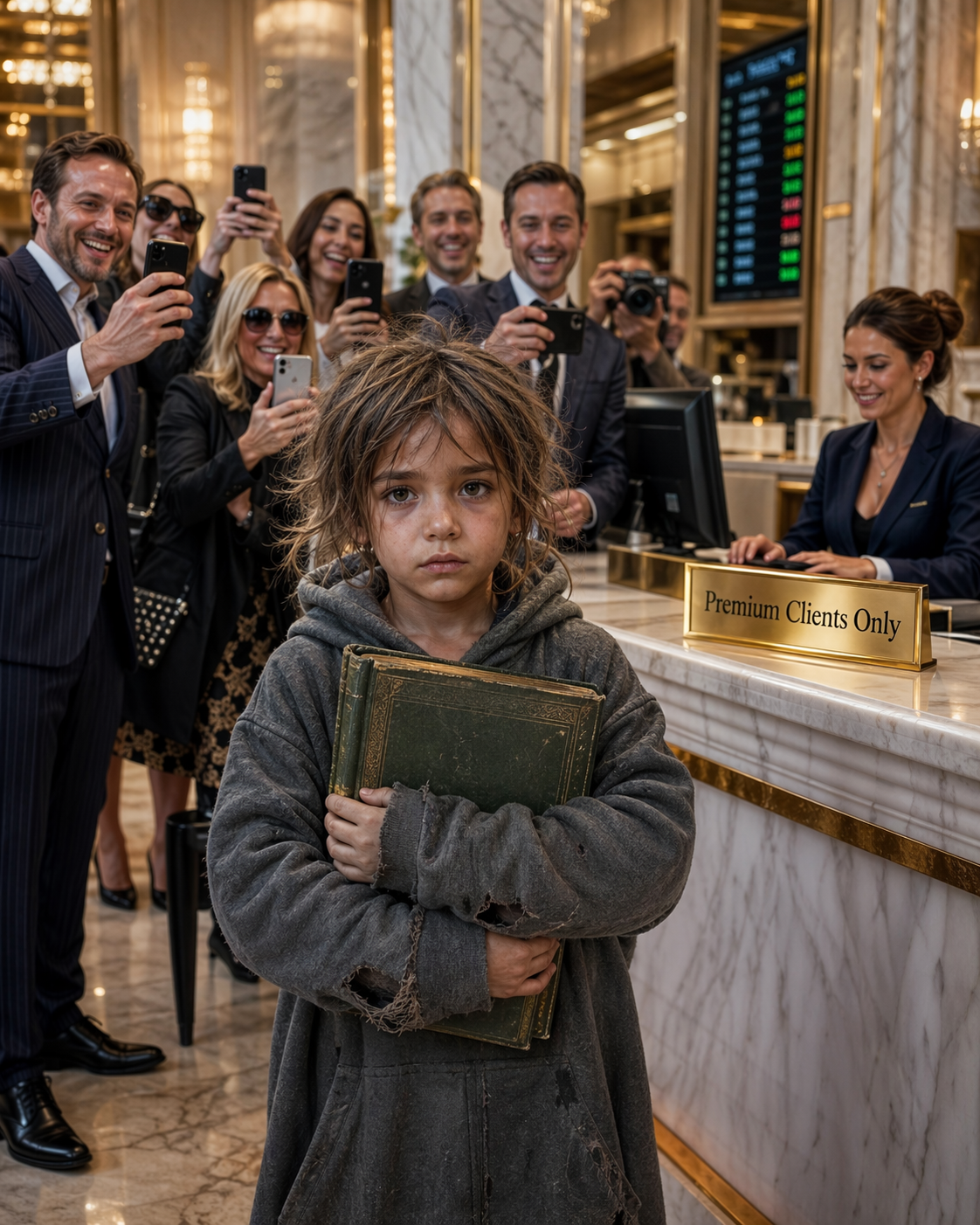
At Eight in the Morning, an Orphan Girl Walked Into the Bank With an Old Passbook—And Moments Later, Everyone Who Mocked Her Fell Silent
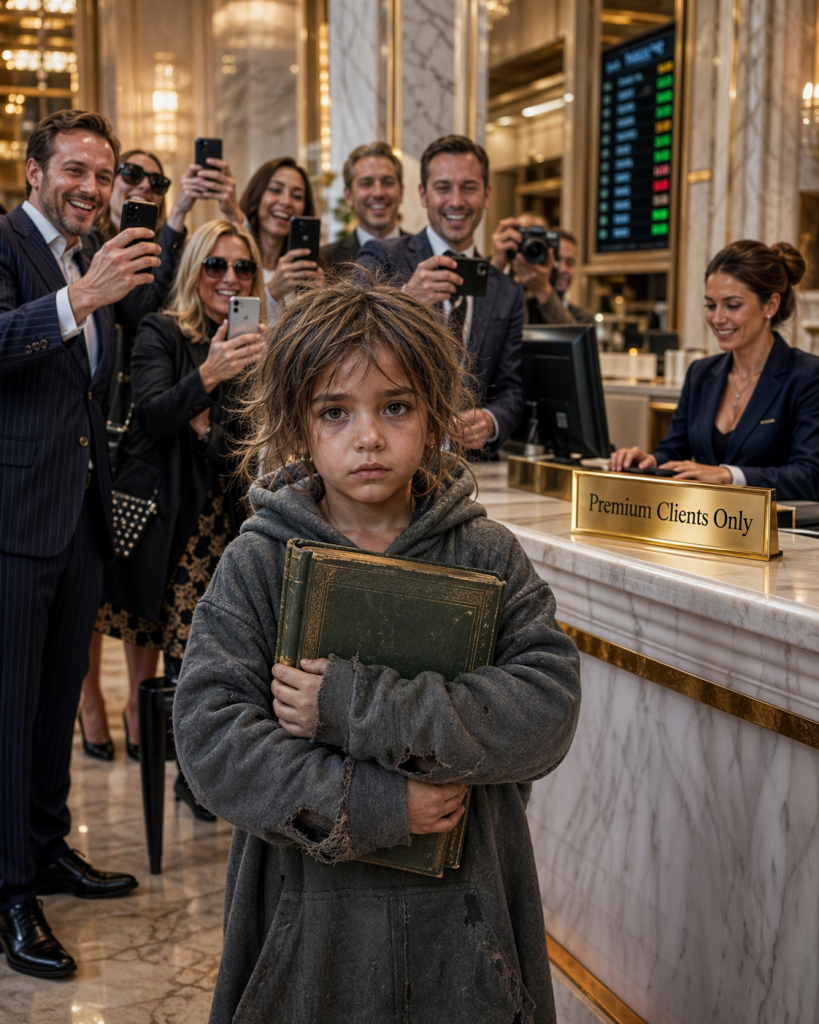
At exactly eight o’clock, when the grand glass doors of a prestigious bank in Mexico City slid open with polished ceremony, a little girl stepped inside carrying grief in both hands.
She looked no older than ten.
Small and quiet, she wore a faded dress with a frayed hem, shoes worn thin at the toes, and hair pulled back carelessly, as though no one had been there to fix it for her that morning. In her hands, she held two things as carefully as if they were sacred relics: a bank card and an old savings passbook, bent at the corners from years of use.
She did not drift toward the waiting chairs. She did not pause to admire the marble floors, mirrored pillars, or glittering lights overhead. She walked straight ahead.
At counter three, a clerk named Patricia was arranging forms into immaculate stacks, already carrying the sharp irritation of someone who hated starting her shift early.
The girl stopped in front of her and lifted the card with both hands.
“I want to know the balance on this card,” she said softly.
Her voice was not loud, but it carried something firmer than volume. It carried purpose. It carried the final errand of someone who had nothing left but duty.
Patricia looked up, scanned the child’s worn clothing, then the passbook, then the cracked skin on her small fingers. Contempt arrived before compassion ever had the chance.
“You’re in the wrong place,” Patricia said coldly. “This desk is for important clients. Smaller accounts are handled downstairs—if that card even belongs to you.”
A man in a charcoal suit standing nearby turned slightly, already amused. Beside him, a heavily perfumed woman glanced over and smiled the way people smile at weakness.
“She probably just followed someone inside,” the woman said loudly enough for others to hear. “Poor thing thought polished floors meant free money.”
Several people laughed.
Not cruelly at first. Not loudly. Just with that effortless social cruelty that makes humiliation feel ordinary when it is directed downward.
But the girl did not retreat.
She placed the card and the old passbook carefully on the counter, aligning them with a precision that felt almost ceremonial.
“My grandfather left them to me,” she said. “He died three months ago. I only want to know how much is there.”
For one brief second, the word died quieted the air.
Then the man in the charcoal suit leaned back and chuckled, as though even tragedy could be turned into entertainment.
“Then let her check,” he said. “Maybe she inherited enough to buy candy for the neighborhood and become a little queen.”
The laughter spread wider this time. Two younger men near the entrance nudged each other. Someone pulled out a phone, already expecting a performance worth sharing later.
Patricia folded her arms and let the sarcasm sharpen.
“And do you even know what a balance is, sweetheart? Or did your grandfather tell you magic numbers live inside cards?”
The little girl’s hand tightened into a fist at her side, but her face remained strangely calm.
“I know what a balance is,” she answered.
Patricia rolled her eyes. “Of course you do.”
There was something about the child’s refusal to shrink that irritated the adults more than her poverty itself. Submission would have made them feel charitable. Dignity made them vicious.
The girl took a small breath.
“Please,” she said. “I just want to know. This was all my grandfather left me.”
By now, the bank lobby had become a stage without anyone formally announcing the play. People stopped pretending not to listen.
At the far end of the room, an older security guard named Ernesto glanced over with growing discomfort. He had seen arrogance before, but children always changed the weight of it.
Patricia sighed theatrically and pulled the keyboard toward herself.
“Fine,” she said. “Let’s check your great fortune. Maybe we’ll all learn a valuable financial lesson this morning.”
A young couple near the brochures laughed again. The man in the suit raised his eyebrows as if he had paid admission and deserved good entertainment.
The girl stood perfectly still while Patricia typed in the card number. The old passbook lay open beside the keyboard, its pages yellowed and stamped with transactions from long ago.
Patricia pressed Enter.
The screen refreshed.
And then she stopped breathing for a second.
Her smirk vanished first. Then the color drained from her face. Her fingers froze over the keyboard as though touching it any longer might burn.
The man in the charcoal suit noticed at once.
“Well?” he asked with a grin. “How much is the empire worth?”
Patricia did not answer.
The perfumed woman leaned forward. “What is it? Negative balance?”
Still Patricia said nothing.
She stared at the screen as if it had opened into something impossible—something dangerous, something powerful enough to end not only her morning, but perhaps much more.
The little girl waited, expression unchanged.
“Please tell me,” she said. “I need to know.”
Patricia swallowed hard. When she finally spoke, her voice came out faint and wrong.
“This account… cannot be processed at this counter.”
That answer only made the room more curious.
The suited man laughed. “What does that even mean? Either it has money or it doesn’t.”
Ernesto was already walking toward the counter, reading Patricia’s posture the way only old workers learn to read trouble before it is spoken.
“What’s happening?” he asked quietly.
Patricia turned the monitor slightly toward him.
Ernesto looked.
Then he straightened so abruptly his knee hit the desk.
The silence in the bank changed instantly. It was no longer amused. No longer relaxed. Now it was alert.
On the screen was not a few hundred pesos, not a modest inheritance, not even an ordinary savings account. It was a private legacy account tied to multiple investment instruments.
The visible liquid balance alone was more money than most people in that lobby would see in several lifetimes. And beyond it were other figures—larger, layered, protected.
Ernesto’s eyes moved from the number to the girl, then back again.
“Señorita,” he said carefully, “what is your name?”
The room heard the change in his tone and understood at once that the story had stopped being funny.
The little girl answered, “My name is Lucía Morales.”
“Who was your grandfather?” Ernesto asked, though something in his face suggested he already feared the answer.
She touched the old passbook with one finger.
“Don Alejandro Morales. He was all I had.”
That name moved through the lobby like an invisible shockwave.
The perfumed woman went pale first. The man in the charcoal suit straightened, his arrogance suddenly choking on recognition. Two employees exchanged horrified looks.
Don Alejandro Morales had been a legend in banking circles, though ordinary clients knew only fragments of the story. Industrial investor. Quiet philanthropist. Ruthless negotiator once feared across half the capital.
More importantly, he had vanished from public life years earlier after a private family tragedy no newspaper had ever fully explained.
Patricia whispered, “No. That’s impossible.”
Lucía looked at her steadily. “He was my grandfather. I lived with him after my mother died.”
The passbook in front of Patricia still carried the old signature sample, faded but intact: Alejandro Morales de la Vega. One of the bank’s most protected historical clients.
Ernesto pressed a trembling finger to his earpiece.
“Call Director Salazar. Now. Immediately. Counter three. Do not ask questions. Just bring him.”
Patricia finally found her voice, but it was brittle with panic.
“There must be some mistake. Maybe the card was stolen. Maybe she found it somewhere.”
Lucía flinched at the word stolen, but she did not cry.
“He gave it to me himself,” she said. “He said when the time came, I should bring both.”
The man in the suit took a step back, as if physical distance might erase the laughter he had already contributed.
“Alejandro Morales had no children left alive.”
Lucía turned toward him.
“My mother was his daughter. Her name was Elena. She died when I was six.”
Something in Ernesto’s face softened at once. He had expected fantasy. He had gotten facts. Facts are far more frightening when you have already behaved badly.
Within less than a minute, the elevator doors opened and Director Salazar emerged, followed by two assistant managers, a legal officer, and a woman from private accounts.
Salazar was a man famous inside the bank for never running.
Now he was almost running.
He reached counter three, saw the account number, saw the passbook, saw the child—and all professional polish drained into something close to awe.
“Señorita,” he said, lowering himself to one knee so his eyes met hers, “did your grandfather tell you to come here personally?”
Lucía nodded.
“He said if anything happened to him, I should wait three months, then come at eight in the morning and ask for the balance.”
Salazar closed his eyes briefly.
The legal officer beside him inhaled sharply. “Three months,” she repeated. “Exactly what the sealed instruction letter required.”
Now the entire lobby was listening without disguise. Phones that had once been raised for mockery were now hidden in embarrassment—or slowly lifted again for a very different reason.
Patricia’s lips parted.
“Instruction letter?”
Salazar rose and looked at her, then at Ernesto, then at the faces gathered around them. He seemed to realize this humiliating spectacle had collected far too many witnesses for comfort.
“Yes,” he said flatly. “Don Alejandro deposited a sealed directive with us years ago. To be opened only if his granddaughter appeared with those two items.”
Lucía instinctively reached for the passbook again, as if fearing that even now someone might decide it was too valuable for a poor child to hold.
Salazar’s voice softened.
“May I see the notebook, Lucía?”
She handed it to him.
He opened to the back cover, where the old leather had curled away from the binding. Tucked inside was a yellowing photograph.
A younger Alejandro sat in a courtyard garden with a tiny red-haired girl in his lap, both squinting into sunlight.
On the back, written in careful ink, were the words:
For when they no longer believe you.
The legal officer covered her mouth.
Patricia looked as though she might faint.
Salazar turned one page farther and found a narrow folded slip sealed with wax so old it had cracked at the edges. The initials A.M. were pressed into it.
He handed it to the legal officer, who opened it with visibly shaking fingers and began to read aloud, because silence was no longer possible.
“To the bank director: if my granddaughter Lucía Morales appears with my passbook and card after my death, receive her with the respect owed my blood.”
The room seemed to grow colder with every word.
“She is sole beneficiary of all personal and protected accounts listed under annexes one through seven, including trust assets, properties, and educational provisions.”
A murmur broke out at once.
But the lawyer kept reading.
“Any employee or client who humiliates, obstructs, or attempts to discredit her on the basis of her appearance is to be identified in writing. Their conduct will reflect the moral worth of this institution.”
No one moved.
It was as though the dead man himself had stepped into the lobby and begun pointing.
The letter continued.
“If my granddaughter arrives alone, it means the adults around her have already failed her. Let the bank not become one more among them.”
That final sentence shattered something in the room that money alone never could have touched.
Lucía blinked quickly, and for the first time her composure trembled—not because of wealth, but because someone had foreseen her loneliness down to the hour.
Director Salazar lowered his head slightly toward her.
“Your grandfather prepared everything very carefully, niña. He wanted you protected.”
Lucía swallowed.
“He said people laugh before they know things.”
The man in the charcoal suit looked at the floor.
The perfumed woman had turned entirely away, as if refusing to be seen could somehow undo the sentence she had thrown into the air minutes earlier.
Patricia suddenly stammered, “I didn’t know. I mean, she looked—”
Salazar wheeled toward her, his anger more powerful for being controlled.
“She looked like a child asking for help. That was enough information.”
No one in that lobby would forget the way he said it.
Ernesto stepped closer to Lucía.
“Would you like to sit down, querida? We can bring you water.”
Lucía hesitated. “I don’t want them to take the card.”
“No one will take anything from you,” Salazar said immediately. “Not here.”
The legal officer, still holding the letter, asked gently, “Did your grandfather leave you with anyone after he passed?”
Lucía nodded once.
“A neighbor. Señora Marta. But she says she can’t keep me much longer because she already has four children.”
There it was.
The real urgency beneath the errand.
She had not come to admire numbers. She had come because time had run out.
Salazar looked as though he had aged ten years in a single minute.
“How long have you been living like that?”
“Since the funeral,” she answered. “Before that I lived with Abuelo in the small house near Coyoacán. He was sick at the end.”
The lawyer asked softly, “And no relatives?”
Lucía shook her head. “Only me.”
The bank director stood fully now, all hesitation gone.
“Clear the private conference room. Call family-trust services. Call our external child advocate. And someone bring breakfast immediately.”
Patricia finally tried to step away from the counter, but Salazar stopped her with a single sentence.
“Do not leave. Human Resources will want your full statement.”